Interview with Warren Gibson

Screen Shot 2020-04-05 at 14.29.43.png

Geoffrey Dean interviews WARREN GIBSON, winemaker for Trinity Hill in Hawkes Bay. In 2005, Winestate magazine named him ‘New Zealand Winemaker of the Year.’

Warren Gibson

Warren Gibson

What's your assessment of the current state of the New Zealand wine industry?

For some time now the general statistics of the NZ wine industry have been hugely biased by Marlborough sauvignon blanc. If you are outside of that particular subset, while you are included in the NZ story, you are in reality quite a different beast. That is not to say that the large increase in Marlborough sauvignon production does not affect those outside this subset.

 I don’t really think there is significantly too much wine made in NZ at present, and it is unlikely there ever will be. The fact is that plantings and production (predominantly of Marlborough sauvignon blanc) have outgrown the immediate and budgeted sales curve. It will balance out in the next few years, particularly as the current environment has essentially stopped new plantings. Any grubbing-up of vines will hopefully come from lesser quality and unsustainable vineyards - this will be good for the industry as a whole.

The unfortunate thing is that we have temporarily compromised the image of the country’s industry by forced and 'stressed' sales to keep the wolf from the door.  I think that there are presently too few producers in NZ creating heritage with their wines and brand. The ones that have will, and are, being rewarded. We need to make a greater proportion of wines here that are more interesting after five years than when bottled.

How much of a stumbling block has the strong NZ dollar been for maintaining exports?

 It is no doubt an issue, but it often seems like a good excuse either from the sales team or importer when they choose not to take the wine on. The strong dollar can help us to reduce production costs – it brings down the price of new French oak barrels for example.  Selling more wine domestically is obviously a smart option but in a limited market such as NZ, the potential is small and the consequences normally are the necessity for 'deals' and discounting to improve the volume of sales.

Is the spread of leafroll virus in the Gimblett Gravels of real concern to Hawkes Bay producers like Trinity Hill?

Yes, it is a problem as it is in other areas of NZ and other countries. However, there is a strong network of people ascertaining the level of the problem, and there are very good plans in place to minimize the issues. Most of the responsible producers in the region have a very good idea of the virus status of their vineyards and are using techniques such as “rogueing” of affected vines and/or complete removal of whole blocks. But given the current industry climate, it is difficult for some owners to justify the cost of removal and replanting. There will also be a certain percentage that will not acknowledge the problem.

th-1.jpg

What makes the Gravels so special?

Well, it is definitely a unique place. It is not an easy place to grow grapes and water stress can be a major issue. What consistently gives the wine quality is the combination of the free-draining nature of the soils and the relatively warm and early harvest which enables a broader range of varieties to reach good maturity. It would be difficult to class the Gravels as a complex soil but this does not seem to compromise the complexity that can be achieved in the syrahs, merlot/cabernet predominant blends and others.

Your own Bilancia La Collina vineyard makes some of the best syrah not just in New Zealand but also in the New World. How did that come to pass?

My wife, Lorraine, and I planted this hillside vineyard overlooking the Gravels in 1998, putting in a little viognier that goes into the syrah. The great unknown was what the wine would taste like from this site. I would like to tell you of all the soil, climate and other tests that we did to prove to ourselves that this would work out the way it has. However, there was a serious element of good fortune. The soil is largely made up of sandstone with some limestone flecking and random limestone boulders amongst the general profile. It faces North-West and is a sun (and wind) trap.

It was not until 2002 that we really made something of note. After a cool 2003 vintage, the vineyard really started kicking in in 2004.  Another lesson often ignored – don’t push young vines into something they aren’t ready for. The great thing is that after five years the vineyard started producing wine with very dramatic red licorice, spice, blackberry and floral aromas and flavour. Something unique was always the aim.

Bordeaux 2010 harvest has huge potential

Screen Shot 2020-04-05 at 14.29.43.png

Geoffrey Dean sends the first report by a foreign journalist from Bordeaux on the 2010 harvest and its huge potential

   Wine lovers around the world will probably not know whether to laugh with joy, or cry at the likelihood of high en primeur prices, when they hear that many leading figures at the leading Bordeaux vineyards believe the 2010 vintage could be as good as that of 2009. From Chateau Canon in St Emilion, where harvesting started this morning, to Lynch-Bages in Margaux to Smith Haut Lafitte in Graves and Domaine de Chevalier in Pessac-Leognan, a consensus has been emerging: 2010 is going to be a wonderful year for both reds and whites if the quality of the fruit is anything to go by.

Gilles Pauquet, who is consulting oenologist for Chateau Canon, Cheval Blanc, and Figeac, could not hide his excitement: "When I took the decision on Tuesday that we would start the harvest at Chateau Canon this morning," he said, "I had never seen this colour, richness and natural concentration in both our merlot and cabernet franc berries. 2010 should be a great year."

Ch Brane Cantenac

Ch Brane Cantenac

In the Medoc, meanwhile, I could hardly fail to notice some very big smiles on faces. "We don't want to say it as no one wants to hear it after 2009 but we think 2010 is going to be extraordinary," Corinne Saussier Conroy, Brane Cantenac's director of marketing and communication, told me when I visited the vineyard on Tuesday. Christophe Capdeville, the estate manager there, got straight down to specifics: "There's lots of sugar in the berries, and a bit more acidity than '09 as well as more tannins. They have more colour and they are richer. Perhaps they are are more concentrated. The cabernet is magnifique...very perfumed. Weather conditions have been ideal...very little water for the vines in a very dry summer, a cool August but some hot weather in September with cold nights. The yield is low."

Nicolas Labenne, Lynch-Bages winemaker

Nicolas Labenne, Lynch-Bages winemaker

When I popped up the D2 to see Nicolas Labenne, winemaker at Lynch-Bages, he went further. "Our cabernet sauvignon is exceptional," he said. "In fact, this looks like being the best cabernet I've seen in my five harvests at Lynch-Bages - better than 2009. The yield is low and the alcohol higher than normal at 13.2%. The cold weather did not help with the flowering of the merlot, but it had no effect on the cabernet. What I will probably do is give the Chateau Lynch Bages a much higher percentage of cabernet in the blend."

A tasting the next morning with Daniel Cathiard, owner of Smith Haut Lafitte, brought yet more predictions of greatness. "Our whites are going to be amazing. There's more freshness and complexity in the juice than last year. We don't dare say it as we didn't think anything could be better than what we made in 2009. But there is so much taste in the sauvignon juice and so much complexity. There's 15-20 seconds of length. We are quite sure we will make great wine this year."

Daniel Cathiard with wife Florence

Daniel Cathiard with wife Florence

I was fortunate enough to drink what was delectable sauvignon blanc juice at Domaine de Chevalier on Wednesday afternoon, the grapes having been picked only that morning. "Nice acidity, nothing but fruit," Remy Edange, general manager there, purred with delightful understatement. We then went to taste the 2009 red ex-barrel. "We are lucky to be alive to try this," he continued. "1982, 2005, 2009 were the very best years here. It's too early to say yet, as our black grapes won't be ready to pick until October, but maybe 2010 could join those three vintages."

Domaine de Chevalier

Domaine de Chevalier


...

Ryder Cup 2008: Kentucky

times-black-ee1e0ce4ed.png

View from the galleries

Geoffrey Dean at Valhalla

September 22 2008, 8:56am, The Times

“Kentucky: Unbridled Spirit” is a motif that this friendly southern state projects from buildings and billboards with an obvious play on its equine and bourbon fame. It could also have applied to the galleries from which I watched the 37th Ryder Cup for all three days, for although they were strongly partisan, they were enthusiastic and generous.

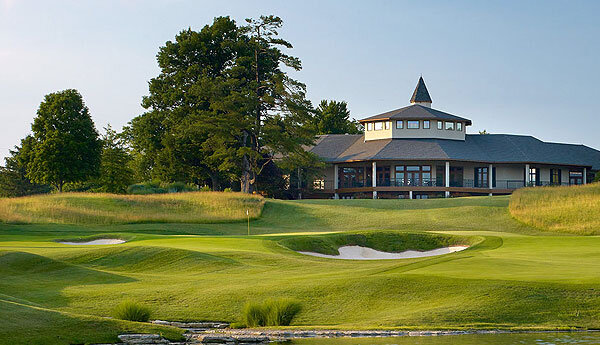
The 18th green beneath the clubhouse

The 18th green beneath the clubhouse

Even when excitement reached fever pitch on the final day, whipped up by a fist-pumping American captain Paul Azinger playing to the stands from his buggy, there was never the remotest chance of a repeat of the infamous scenes of 1999 at Brookline. Kentuckians, at once fair, polite and gracious, would not descend to those levels, even if there were some boos for Lee Westwood and Soren Hansen on Saturday afternoon when they did not concede a two-footer to Boo Weekley and J.B. Holmes on the 15th green.

While the arm-raising proclivities of Weekley and Anthony Kim were an over-the-top ploy to lift already high noise levels, there were plenty of signs that pumped-up players were still able to embrace the cup’s traditional ethos. After Paul Casey and Hunter Mahan had each hit stunning long iron shots to within a couple of feet on the 215-yard par-three 14th in their epic tussle, both conceded the other’s put and high-fived on the green. The crowd had already given them a standing ovation.

The 6th hole at Valhalla

The 6th hole at Valhalla

Relations between the two sets of supporters were cordial throughout. Europeans in fancy dress (an alien concept to the American sports follower) were asked to pose for photographs by the host fans, and a Kentuckian friend remarked how much he had enjoyed the rivalry on the two stands by the first tee on Sunday morning. About a hundred or so European fans waving blue flags had made almost as much noise as five times as many home supporters when players were introduced by the starter.

Humour, normally the preserve of European fans brought up on cheeky football chants, was touched by Americans alongside the 13th fairway shortly before Kim wrapped up victory over Sergio Garcia. The European fans’ favourite call of “Ole, Ole, Ole, Ole” was replaced with a home version, to the same tune, of “No Way, No Way, No Way, No Way”. They sensed, quite rightly, that a European win was not going to happen.

The victorious American team celebrate

The victorious American team celebrate

A more mischievous attempt at comedy had come from one spectator on Saturday after Westwood’s complaint the night before about Weekley’s behaviour. “Hey, Lee, do you want some cheese with your whine?” yelled the man, to some of the crowd’s amusement. At least, in the absence of Tiger Woods, I did not hear a single shout over the three days of “You’re the man.” Instead, there were numerous exclamations of “Holy Cow” after Holmes’s many monster drives.

Holmes’s approach to golf befits a resident of Louisville which, a couple of years ago, was coined as “Possibility City” by the mayor’s office and local chamber of commerce to attract talent and business. It is an epithet that neatly supports the great American dream: in this case, to reclaim the Ryder Cup.

Geoffrey Dean was a guest at the Ryder Cup of Kentucky Tourism. He travelled with Delta Air Lines, who fly daily from Gatwick direct to Northern Kentucky Aiport. www.kentuckytourism.com