Discovering the hidden gems of Collio DOC

Whether it’s its tiny size, proximity to Slovenia or its remote hilly location, very little is known about the hidden gem of a wine region that is Collio Gorizia DOC in the North East of Italy. With almost 90% of vineyards planted to white varieties, and multi-generational winemaker families, Geoffrey Dean found a treasure trove of quality white wines – from the cult skin contact wines of Sasa Radikon to the many examples of wines made from Friulano, Malvasia and Pinot Grigio.

By Geoffrey Dean February 2, 2022

...“Central to the whole identity of the Collio is the long family history of winemakers, several of whose surnames sound more Slovenian than Italian,” writes Dean.

Wine writers and drinkers alike love nothing better than to uncover a hidden gem of a region that produces good wine. Given that Collio Gorizia (Collio for short) is the third oldest DOC in Italy, it might seem a misnomer to call it ‘hidden,’ but to the majority of UK consumers it has remained largely unknown.


Perhaps, it is its tiny size – a slither of land shaped like a half-moon or croissant that is 20 km long and barely 4km across at its widest point; or maybe it is its remote, hilly location, bordering Slovenia in the top right-hand corner of Italy near the town of Gorizia in Friuli Venezia Giulia. What is not in doubt, though, is the quality of the Collio’s wines and the skill of its winemakers, many of whom are aiming for greater distribution in the UK.


Getting to know the grape varieties of Collio DOC

While the Collio region produces some premium red wines, it has won a deserved reputation among cognoscenti for some of Italy’s most prestigious whites. Indeed, 87% of its 1500 hectares under vine are planted to white varietals. Pinot Grigio is the most common (comprising 26% of all plantings), closely followed by Sauvignon Blanc (19%), but many of the most interesting white wines are made from Friulano (14%), Ribolla Gialla (10%) and Malvasia Istriana (3%).

Formerly known as Tocai Friulano, until the EU banned the name in 2008 after pressure from Tokaj producers in Hungary, Friulano has been proved by ampelography and DNA profiling to be Sauvignonasse. Introduced into Friuli in the early 19th century, Friulano has almond and herbal notes as well as a fuller body than Sauvignon Blanc if less acidity and aroma. Notable producers of it include Felluga, Castello di Spessa, Zorzon, Bracco, Fruscalzo, Humar, Formentini, Villanova and Bolzicco.

Ribolla Gialla is an indigenous variety from Friuli, dating back to the 13th century. First written mention of it can be traced back to 1296 when the Pope settled a dispute about its sales between the bishop of Trieste and a monastery in Venice. The village of Oslavia, a stone’s throw from the Slovenian border, is regarded as the varietal’s spiritual home, with fermentation traditionally done on the skins, with many orange wines resulting. Oslavia producers include Radikon, Fiegl, Gravner, Princic, Primosic and La Castellada, while Korsic, Mania and Marcuzzi also make good white versions of Ribolla in Floriano del Collio.

Malvasia Istriana has been grown in the Collio almost as long – since the 14th century – although it is likely to have originated in what is now north-west Croatia. We encountered some superb dry examples of it, with many showing floral perfume notes as well as hints of salt and spice. Two fine examples of it are listed below, but others come from Casa delle Rose, Pascolo, Il Carpino and Colmello di Grotta.

Soil, wine styles and a sense of history 

The Collio’s complex soil structure features clay, sand, silt and minuscule marine fossils. “This layering of different soil types is called ‘flysch’ and it’s the secret ingredient behind our wines, giving minerality,” Paolo Bianchi, former director of the Collio Consorzio, declared.  The Collio also benefits both from the cool winds from the east and warm sea-breezes from the nearby Adriatic, which help dry out vineyards in what is one of Italy’s wetter regions. Another key climactic factor is the region’s wide diurnal range, which helps to explain the notable freshness evident in Collio wines of all colours.

The Collio’s production code permits 18 official wines that qualify for DOC status, with the vast majority being single varietals (12 white and four red as well as two blends – Collio Bianco and Collio Rosso). There are also sub-zones within the DOC – examples including Oslavia, Plessiva, Pradis and Zegla. Locals proudly liken them to Crus in Burgundy.

Grappa Nonino, 2019’s best distillery in the world

Central to the whole identity of the Collio is the long family history of winemakers, several of whose surnames sound more Slovenian than Italian. The area, originally part of the Austro-Hungarian empire, was a fierce battleground in the Great War, with trenches still in evidence, and after the Second World War, the hills were split between Italy and Yugoslavia. Only in 2008, when Slovenia gained independence, were boundary controls lifted. At one point during our winery visits, we cut through Slovenia to do one side of a triangle instead of two.

No appraisal of Collio would be complete without mention of Grappa Nonino, which was voted best distillery in the world in 2019 by Wine Enthusiast. Founded in 1897, it is situated a few kilometres outside the Collio region but is part of its DNA. Its grappa is amongst Italy’s finest, while its Quintessentia Amaro Nonino, a liqueur, was winner of the Ultimate Spirits Challenge in 2021.

12 wines from Collio that caught the eye

Stella’s Erika Barbieri

Tenuta Stella, Malvasia Istriana DOC Collio 2019

Talented winemaker Erika Barbieri has crafted a superb Malvasia from very low-yielding, organically-farmed vines of 15-20 years age; wild yeasts add complexity while 60% malolactic fermentation gives extra body and richness; a complex wine that spent ten months in untoasted casks.

Tenuta Villanova, Friulano DOC Collio 2019

The same family has owned the Villanova estate since 1932 and have 100ha under vine; very expressive nose with apricot, apple and spice aromas; spent six months on the lees in concrete tanks, giving it complexity and body; elegant with pronounced acidity.

Bolzicco, Friulano DOC Collio 2019

From 1960s vines, this is another fine example of Friulano that saw only stainless steel; lots of freshness, concentration and length as well as some saltiness and characteristic almond notes on the palate.

Livon, Malvasia Istriana Soluna DOC Collio 2020

From low-yielding vines on Ponca soil, consisting of layers of minerals from the prehistoric sea bed as well as clay and limestone (in the village of Ruttars). Herbal sage notes give way to attractive citrus fruit; velvety creaminess from eight months on lees (80% stainless steel, 20% used oak); also possessing notable minerality and excellent length.

Marcuzzi, Ribolla Gialla DOC Collio 2019

Appealing apricot and peach flavours on this single varietal Ribolla Gialla, made by Riccardo Marcuzzi. Excellent freshness and length. A good food wine, especially with risotto.

Sasa Radikon

Radikon, Ribolla Gialla IGT Venezia Giulia 2017

Sasa Radikon has a cult following for his whole range, notably this orange wine. “Orange wines were re-born here thanks to two men – my late father Stanko and Boris Primosic,” Radikon told me. “Why do we use Ribolla Gialla? Because it has a thick skin.” He revealed his sunset-coloured orange wine underwent skin contact for three months and had no sulphur dioxide added to it. Very complex with quince, orange zest and apricot notes, this big-textured wine has vibrant acidity.

Tenuta Angoris, Pinot Grigio DOC Collio 2020

Light copper colour thanks to cold maceration on the skins for ten hours. Very fresh acidity and saltiness counter-balances 13.5% abv. 5% spent ten months in old oak tonneaux with the rest in stainless steel. Time on lees gives body and softness to a wine that is a pleasure to drink.

Fruscalzo, Pinot Grigio DOC Collio 2019

Clean with no pink hue despite some skin contact which gives it a bright straw colour. Elegant and fresh with peach and pear notes as well as some subtle oiliness.

Tenute Marco Felluga e Russiz Superiore, Sauvignon Blanc DOC Collio 2020

Sauvignon Blanc was planted as long as 150 years ago in Collio, and this fine example has herbal aromas with passion fruit notes. Clean, elegant and refined, it is quite full-bodied at 13.5% abv but has vibrant acidity to counter-balance. Very persistent finish.

Gradis’Ciutta, Riserva Collio Bianco DOC 2016

Robert Princic, who also makes good Pinot Grigio and Sauvignon Blanc, has fashioned an alluring blend of Friulano, Malvasia and Ribolla Gialla. Until 1992, when ‘international’ varieties were added, these were the only grapes that were permitted. Complex and long, while still fresh, this underlines how well the blend works.

Tenuta Baroni del Mestri, Merlot Barone di Schoenberg DOC Collio 2018

A good illustration of how Collio can also produce high quality reds. This single varietal Merlot went through 21 days of maceration and was matured in oak barriques, 25% being new. Lovely plummy fruit with freshness, concentration, well-integrated tannins and impressive length.

Tenuta Stella, Pinot Nero DOC Collio 2019

There are only eight hectares of Pinot Noir under vine in the Collio, but this lightly-coloured, delicate and elegant example impressed. From 60-year old hillside vines that are a mixture of clones, it showed some classy raspberry and cherry fruit as well as structure from maturation in 50% new barriques. Untoasted, these included some Friulian mulberry, which adds roundness and is less intrusive.
Where in the UK can you buy these wines?


  • Russiz Superiore (Berkman)

  • Castello di Spessa (Delitalia, Barnsley)

  • Tenuta Borgo Conventi (Annessa Imports, London)

  • Tenuta Stella (Pandemonio di Luca Dusi, London)

  • Fruscalzo (Colosseum Wines, Scotland)

  • Livon (Eurowines)

  • Primosic (FortyFive 10 degrees)

  • Radikon (Dynamic Wines)

  • Gravner (Raeburn Fine Wines)

  • Fiegl (Virgin Wines)

  • Dario Princic (Les Caves de Pyrene)


How 2020 was a freak year in Burgundy

The 2020 vintage was the hottest year ever in Burgundy – beating even 2003 and previous hottest vintage 2018 – and there were also drought issues. Miraculously, however, there are no signs in the wines of over-ripeness or cooked characters and, writes Geoffrey Dean, there is the right amount of structure and substance to allow these wines to age for a considerable length of time. Dean hears from Albert Bichot’s team of the technical adjustments they made to cope with the challenges and recommends six of the wines from its extensive range that you need to have on your buying radar.

By Geoffrey DeanJanuary 13, 2022

.“The hottest vintage ever,” professed Matthieu Mangenot, Albert Bichot’s assistant technical director, during the leading Burgundy producer’s trade tasting of the 2020 vintage in London in December. And after sampling eight whites and 16 reds from their six Burgundian estates, it was clear that 2020 is a very fine vintage that will give drinkers a huge amount of pleasure.

The 2020 vintage will also go down as a visual freak – for the reds that is. They have so much colour that drinkers will be forgiven for wondering if it is indeed a glass of Burgundian Pinot Noir in front of them. “It is a very dark colour and not normal,” Mangenot admitted. “We were surprised how Pinot could give such good colour, but there is no sign of over-extraction – it is the vintage.” Richard Bampfield MW, Albert Bichot’s longtime UK brand ambassador, concurred that the hues of the 2020s were “unique over the last 20 years.”

It is possible of course that the heat of 2020 was a key factor behind the deeper colour of the Pinot Noirs. “2020 was much higher in terms of polyphenols even than 2015, which had the previous record,” Mangenot continued. Yet the 2018 vintage, which he said was the previous hottest, did not see the same colour.

Matthieu Mangenot and export director Delphine de la Fouchardiere in London, Dec 2021

“We had to deal with several issues which were quite challenging. If you look at the figures, 2020 is the hottest vintage ever. Even 2003 was a bit cooler compared to 2020. We were a bit frightened by the climactic conditions of the vintage as we had in mind what happened in 2003 and the balances of the wines then, but 2020 was totally different to 2003 – you can’t really compare the two. Because of the water shortage the Chardonnay slowed down and we had quite a hectic maturation process…kind of stop and go with the maturity affected by the lack of water. Chardonnay was more affected than the reds by the water shortage. The concentration increased thanks to the heat and the north wind. There were no issues of sorting, though, and the fruit aromas were not overcooked.”

Mangenot revealed that very slow extraction, longer cold soaking and extra whole bunch maceration had been three important technical adjustments for the 2020 vintage. “The idea was to extract very slowly and get as much fruitiness and expression of the terroir as we could. We used a bit more cold soaking: 5-7 days to get more fruit and freshness. We also did a little bit more whole bunch maceration – more than the 20% we normally do. It was up to 40-50% in some wines. It did not increase acidity levels if you look at the lab results but did help freshness. It also lowered alcohol levels a bit too. We also moved from pigeage to pumpovers, and got good results here with the freshness. Bottling was a bit earlier than normal to help retain that freshness.”

The importance of when to pick was especially acute in 2020 but the signs are that Albert Bichot got it right in its six estates: Domaine Long-Depaquit in Chablis, Domaine du Clos Frantin and Domaine du Château-Gris in Nuits-St-Georges, Domaine du Pavillon in Pommard, Domaine Adélie in Mercurey and Domaine de Rochegrès in Moulin-à-Vent. Although harvest was earlier than usual, so was budburst, which meant that the desired 100 days of ripening elapsed between flowering and picking.

No cooked characters or over-ripeness were evident in the wines tasted. Importantly, they look to have the combination of substance and structure to last. The oak regime appears to have been skilfully judged, with no over-oakiness apparent. Between 20-35% new oak was used for the whites, and 30-40% for the reds.

Six wines that stood out from Albert Bichot in 2020


Meursault 1er Cru ‘Les Charmes’, 2020, Domaine du Pavillon

Intense citrus notes with fabulous concentration; exceptional length

Chablis Grand Cru ‘Moutonne Monopole’, 2020, Domaine Long-Depaquit

Pronounced minerality; very attractive fruit and steely line of acidity

Corton Charlemagne Grand Cru, 2020, Domaine du Pavillon

Magisterial, complex Corton with remarkable concentration, intensity and length


Chambolle Musigny 1er Cru ‘Les Chabiots’, 2020

Very seductive red fruit with herbal notes; elegant with silky tannins and a very long finish

Corton Grand Cru ‘Clos des Marechaudes’ Monopole, 2020, Domaine du Pavillon

Complex with excellent length and lots of freshness; quality tannins with a silky thread; power yet finesse

Echezeaux Grand Cru, 2020, Domaine du Clos Frantin

A veritable tour de force with delectable concentrated fruit, super fine tannins and great persistence


Top 10 wines of 2021

It comes as little surprise that five of Geoffrey Dean’s Top wines of 2021 are from South African estates. Dean is a massive fan of South African wine and, in a window of opportunity, he managed to get to SA in 2021 for a blissful five weeks of catching up with old friends and discovering new wines. These are the wines that stood out and which he would recommend, plus five more from across the globe.

Anwilka, Stellenbosch 2017, Western Cape 14% abv

An exceptional blend of Cabernet Sauvignon (47%), Syrah (46%) and Petit Verdot (7%). Seductive herbal and boysenberry aromas greet you before top-notch Helderberg fruit dances on the palate with its blackberry and cassis notes. While it has power and weight, with added structure from 19 months in 400-litre barrels, 50% of which were new, the tannin structure, while quite overt, is supple. Concentrated, complex and long, this ‘lekker’ wine has a long life ahead of it.

Château Pesquié, Cuvée Juliette, AOC Ventoux 2020, 13.5% abv

This blend of Clairette (70%) and Grenache Blanc (30%) from an estate at the foot of Mont Ventoux is blessed with wonderful purity of citrus fruit and freshness. From biodynamically-farmed vines grown at 300m on limestone and clay soils, the wine is vinified in concrete eggs with malolactic fermentation blocked. Salinity and minerality are hallmarks of this delightful production of 2000 bottles named after the dame of the Chaudière family that owns the estate, Juliette.

Chêne Bleu, Pont des Arts Rouge Vieilles Vignes Réserve Spéciale 2015, IGP Vaucluse, 14% abv

Just 1200 bottles of this blend of old vine Grenache (55%) and Syrah (35%), with a touch of Mourvèdre, were made from fruit grown at 500m on the steep, rocky slopes of the Chêne Bleu winery in the southern Rhône Valley. Thibault Pontallier, son of the late Paul of Château Margaux fame, collaborated in its production, and the result is a masterly cuvée, notable for its elegance, refined tannins and fresh acidity. Blackcurrant and black cherry fruit, along with notes of rosemary and black pepper, make this an absolute delight to drink now, even if it has clear cellaring potential. Art lovers will enjoy the label, one of Dutchman Piet Mondrain’s iconic works from 1921.

Domaine de Mourchon, Family Syrah, AOC Côtes du Rhône Villages 2018, 14.5% abv

The winery was founded by a Briton, Walter McKinlay, in 1998 when he bought a parcel of land at 350m above the picturesque village of Séguret, just north of Gigondas. His daughter Kate now runs the estate with her husband Hugo Levingston, while Sebastien Magnouac makes the wine. From 60-year old vines yielding only 15hl/ha, this Family Syrah has glorious red and black fruit with suave high quality tannins. Matured in old oak 600l demi-muids for two years.

Duca di Salaparuta, Duca Enrico 2017, Terre Siciliane IGP, 14% abv

A superb single varietal example of Sicily’s indigenous Nero d’Avola grape. Produced from fruit on the Duca di Salaparuta’s prime estate, Tenuta Suor Marchesa, this flagship label is already very approachable for a varietal renowned for its high levels of tannins. Maturation for 18 months in old oak, followed by 18 months in bottle before release, have proved beneficial. The tannins are soft, while the red plum and balsamic notes, with hints of rhubarb and medicinal herbs, are very beguiling as are the wine’s freshness and length.

Flagstone Winery, Time Manner Place, Pinotage 2017, Breedekloof, Western Cape 14.5% abv

One of South Africa’s great Pinotages. From a tiny, low-yielding high altitude parcel in the Breedekloof district in the Breede River Valley, this has complex blueberry and red cherry fruit, smoky dark chocolate and roast nut notes with mocha, cigar box and mint aromas. It effortlessly absorbs 100% new oak (a mix of French, American and Hungarian) which adds richness and structure. Mineral freshness, well-integrated quality tannins and a very lengthy finish make this a wine to cherish. Take a bow Gerhard Swart, head winemaker.

Klein Constantia, Block 382, Sauvignon Blanc 2018, Constantia, Western Cape 13.5% abv

No South African winery can boast a grander range of Sauvignon than Klein Constantia. It has 43 different blocks of the varietal, and has identified the six top terroir-driven single vineyard sites. Block 382 is perhaps the most special, located on a higher-lying E/SE facing slope. Winemaker Matt Day has crafted a beautifully pure expression of the varietal that is captivatingly aromatic with wild scrub and nettle notes with granadilla and passion fruit on the palate. Eight months on the lees in old 500-litre oak barrels adds some richness, which is counter-balanced by flinty minerality and vibrant acidity. The finish lingers on and on.

Muratie Wine Estate, Ansela van de Caab 2017, Stellenbosch, Western Cape, 14% abv

One of the oldest and most beautiful farms in the western Cape, dating back to 1685, Muratie is situated on the higher ranges of the Simonsberg to the north of Stellenbosch. Longtime owners Rijk Melck and his family have nurtured the most enticing of destinations, with its home cooking and regular live bands, and their winemaker Hattingh de Villiers has lifted their Bordeaux blend (50% Cabernet Sauvignon, with the rest being Merlot, Cabernet Franc and Petit Verdot) to new levels. Given structure by 60% new oak, in which it spent 24 months, it is a complex, multi-layered wine with tremendous concentration. Cassis, blackcurrant, plum and violet notes with fine-grained tannins and a very persistent finish.

Pikes, Traditionale Riesling 2021, Clare Valley, South Australia, 11.5% abv

A brilliant example of Clare Valley riesling from the Pikes winery, which goes from strength to strength after being founded in 1984. Andrew Pike, managing director as well as viticulturist, produces top-quality fruit from immaculately-tended Polish Hill vineyards. Winemaker Steve Baraglia profits from a very low pH of 2.93 to fashion a delicate wine with a mouthwatering backbone of acidity and glorious fresh lime intensity. Throw in citrus blossom and mineral notes, as well a dash of residual sugar (4.6g/l) to counter TA of 8.22g/l, and you have a well-balanced, extremely concentrated but refined wine with a seamless and lengthy finish.

Simon Halliday and Geoffrey Dean (r) tasting Doddie’s wine at Handford

Schalk Burger & Sons, Doddie’5 Red Blend 2019, Groenberg, Western Cape, 14% abv

Rugby fans should look no further than this outstanding blend of five cultivars – Cabernet Sauvignon, Cabernet Franc, Merlot, Mourvèdre and Petit Verdot. Made by former Springbok lock Schalk Burger senior and his younger son Tiaan, it is named Doddie’5 in honour of Doddie Weir, who wore the no. 5 shirt for Scotland and the British Lions in his heyday but who has been stricken with Motor Neurone Disease. Distributed in the UK by former England back Simon Halliday’s Sporting Wine Club, £5 from the £20 RRP goes towards Weir’s ‘My Name’5 Doddie Foundation’, which seeks a cure for MND. All the fruit came from the Burgers’ Welbedacht Estate near Wellington in the Groenberg ward. You can read more about this remarkable wine by clicking here.


Tasting Cheval Blanc 2005 & 2009

100,000 meals delivered to children in need was the serious purpose of a once-in-a-lifetime charity dinner at The Birley Wine Club last week. The frivolous side was drinking Krug, Cheval Blanc 2005 and 2009 as well as rounding the evening off with Yquem 2011. For Geoffrey Dean it was a rare opportunity to see how the vintages are evolving, with the ‘vintage of the millennium’, the 2005, possessing the structure and freshness to take it easily into the 2030s and beyond.

By Geoffrey DeanDecember 24, 2021

“You could say this was the vintage where winegrowers could sit back and relax in an armchair,” said technical director Pierre-Olivier Clouet, about the 2009 Cheval Blanc.

Much credit must go to the Birley Wine Club, and its members and guests, for raising £102,000 at a charity wine auction dinner at Annabel’s in London in early December. If patrons were fortunate enough to drink Cheval Blanc from both the great 2005 and 2009 vintages as well as Krug NV and Yquem 2011, they dipped into their pockets to bid generously for several lots of classic wines from Bordeaux, Burgundy, Champagne and Italy.

More on the wines drunk later but, given the proximity to Christmas, first a word on where the proceeds raised are going – to the Food from the Heart Campaign. This was launched last year by the Caring Family Foundation, which estimates that two million children face food insecurity in the UK each month. “This Christmas, we aim to distribute 100,000 meals to children in need,” revealed Richard Caring, adding that the foundation that he and his wife Patricia set up is funding projects both in the UK and Brazil. These are supporting both women and children’s causes by working closely with grassroots organisations to have a long-term impact.

The fact that Pierre Lurton, the CEO of Château Cheval Blanc and Château d’Yquem, flew in from France to attend the dinner underlined his brands’ commitment to the evening. He admitted that the 2021 vintage in Bordeaux was looking “average’ but there was nothing average about the vintages of the wines that were tasted.

First the 2005 Cheval Blanc. Pierre-Olivier Clouet, the winery’s technical director, considers it one of the greatest vintages of the millennium. “Yes Cheval Blanc 2005 is a very great wine, and it’s not hard to see why,” he said. “Drought conditions set in very early and lasted throughout the growing season, having a beneficial effect. This resulted in a correspondingly early stop to vegetative growth, an early start to ripening and very small berries. These small grapes were remarkably concentrated in terms of colour, aroma, tannin and acidity. This added up to a perfectly complete wine.”

The figures for 2005 are telling. As few as 344 millimetres of rain between January and September (compared to the average of 572) in what was a very warm year (temperatures between April and September being 1.7C higher than the seasonal average). The sugar levels were unprecedented but the fruit was not excessively ripe or candied. Acidity levels were a little lower than normal but a pH of 3.92 meant total SO2 levels were not unduly high at 94 mg/l.

The wine itself (14% abv) was exceptionally dark, deep and intense. Rich in every aspect, it had concentrated black fruit on the palate and a beautiful tannic texture. If power and richness came from the Merlot (51%), elegance and complexity was provided by the Cabernet Franc (49%). It has a long life ahead of it, with enough freshness and structure to last well into the 2030s or longer.

As for the 2009 Cheval Blanc, Clouet described it as another great vintage. “Stage after stage of the growing season took place seamlessly and under ideal conditions,” he said. “You could say this was the vintage where winegrowers could sit back and relax in an armchair. Flowering occurred quickly and evenly at just the right time, as did veraison. Ripening took place uninterrupted over a long period, and we were able to start picking in mid-September – one plot after the next, each at optimum maturity since the weather was so cooperative.

“We often say at Cheval Blanc that we like to pick the fruit at ‘al dente’ when the grapes are juicy and fresh. We tasted them as soon as they arrived in the cellar as we did the first must. It was clear the wine would be very full-bodied and generous. There was an incredible odour of cherry and raspberry in the cellar, and we were sure a great vintage was in the making. What makes Cheval Blanc so unusual is that the Cabernet Franc adds inimitable freshness and elegance, with hints of menthol and eucalyptus, resulting in a delicate balance and great ageing potential thanks to its tannic backbone.”

These tannins in the 2009 are so fine-grained that they melt in the mouth, feeling silky on the mid-palate. Seductive floral aromas, including violet, and a cornucopia of notes of fresh fig, blackcurrant, blackberry, raspberry and mint were apparent. Above all, there was perfect balance between exuberant concentration and finesse thanks to the wine’s remarkable freshness (probably enhanced by a lower pH of 3.71). Abv again came in at 14%.

The Yquem 2011 was creamy and opulent in a year where conditions were perfect for noble rot. Five ‘tris’ or passes through the vines were made to pick the grapes, according to Sandrine Garbay, Yquem’s head winemaker.  “Our average yield is still only about 10 hl/ha, but the level of residual sugar has gone up,” she said. “It always used to be 100-110 g/l but now we aim for 120-140g/l. The main changes since I took over as cellar master in 1998 have been to lower the time of ageing in barrels from 36 to 24 months, and to limit the introduction of air into wines during barrel-ageing. We rack from barrel to barrel without air, which helps to preserve the fruits aromas in the wine, particularly the thiols. That’s why our wines are now quite better to drink young, even two years after bottling because the fruits are there.


Whisky tourism in Islay

8 amazing Islay whisky distilleries to discover

15 DECEMBER 2021

By Geoffrey Dean

Now that we’re well into fireside sipping season, Geoffrey Dean reveals the key differences between Islay’s gems, from peaty and smoky to fruit-forward, as well as where to try them.

For the whisky lover, there is nowhere quite like Islay. The southernmost island of the Inner Hebrides, which lies just 25 miles from Northern Ireland, has nine distilleries, with a tenth under construction and a couple more in the planning phase.

In addition, the old Port Ellen distillery is being redeveloped and brought back into production. Several Islay brands enjoy legendary status among cognoscenti, and each one has its own special characteristics and different on-site experience.

Islay is Scotland’s fifth biggest island, being 25 miles from top to bottom and 15 across at its widest point. Throw in the friendliest of local residents (who number 3,250), a variety of accommodation from cottages to comfortable hotels, one of Scotland’s best golf courses (the Machrie) and some stunning scenery, and you have all the ingredients for a memorable whisky tourism holiday.

1.Ardnahoe

Islay’s newest distillery started production in 2018. The owners had a ceremonial opening of a single malt cask in early November – to mark its ascension to Scotch status after the obligatory three years maturation in oak – but do not plan to release any whisky for sale for another couple of years. Their elevated visitor centre should not be missed, for its views to the east towards the neighbouring island of Jura are breathtakingly beautiful. A very large lounge and restaurant area are ideal for morning coffee or lunch, while multiple experiences are available as Paul Graham, the visitor centre operations manager, explained. “We have the most varied experiences of all the distilleries on

Islay,” he said. “You can go right through the production process; you can do the warehouse experience, the blending experience, food and whisky pairings. There is a daily tasting at 3pm from wine, Bourbon and sherry casks as well as two tours per day, at 10am and 4pm. Ours is a pretty unique Islay whisky, with fruit at the front followed by smoke at the back – a sort of role reversal of your usual Islay single malt.”

2.Bunnahabhain

A couple of miles to the north of Ardnahoe, along a narrow winding road is Bunnahabhain, a distinguished distillery celebrating its 140th anniversary this year.  Right by the sea, with its own jetty, Bunnahabhain also enjoys superb views across to Jura as well as to Colonsay and Mull to the north. Its new visitor centre is not as big as Ardnahoe’s but what it does have is 30 different labels, most single casks, in the shop. Billy Sinclair, the visitor centre manager,

revealed it sells about 10,000 20cl bottles per annum to visitors, who relish the huge variety of different types of vessels – around 15 – that the distillery uses for maturation. While 70% of Bunnahabhain’s casks are sherry butts for Manzanilla, Oloroso, Amontillado, Palo Cortado and Pedro Ximenez, also used are red and white wine barriques from Italy, Spain and France as well as Port, Calvados, Madeira and Marsala vessels. And of course, Bourbon.  Many of these can be tried at the daily 10.30am and 2.30pm tastings. Bunnahabhain’s unique selling point is that, while the rest of Islay’s whiskies are largely peated, 80% of its products are unpeated. “Our 12, 18 and 25-year old single malts are all unpeated,” Sinclair said. “Our peated labels have about 40-45 parts per million of peat, which is about the same as Lagavulin and Caol Ila but they have a very different taste because of the nature of the spirit. Our stills are massive and we only fill them about a third, so you get a huge amount of copper contact, leading to a lighter, softer more delicate spirit without very many of the heavier medicinal phenols.”


3. Bowmore

From Bunnahabhain, it is a 12-mile drive or cycle to the Bowmore distillery in the centre of the island. En route, you pass the Ballygrant Inn, which has one of the great national collection of Scottish whiskies. Bowmore’s maturation warehouse is the oldest in Scotland, dating back to 1779, and according to distillery manager, David Turner, Bowmore is one of only six Scottish producers who malt some of their own barley. The others are Laphroaig, Kilchoman,

Springbank, Balvenie and Highland Park.  “The tropical fruit flavours that Bowmore are renowned for all start in the malt barns,” Turner said. “We in the centre of Islay are a middlingly peated distillery, with those in the north being lightly peated and the south more heavily so. We use predominantly Bourbon casks for maturation, but 22%

are sherry butts and we’ve also been using wine and port vessels for many years.”  What is an excellent visitor centre at Bowmore attracts around 24,000 visitors a year.

4.Bruichladdich

Just across from Bowmore, although it is an 8-mile drive around the bay, lies Bruichladdich and its extremely impressive visitor centre and shop. Master distiller Adam Hannett took me into the distillery warehouse, a treasure trove of more than 200 different single casks, some of which came from the most famous wineries in Sauternes and

Pomerol as well as Chapoutier in the Rhone. The reddish hue in the whiskies matured in red wine barriques was noticeable. The forward-thinking Hannett delights in experimentation, having started whisky production from rye in 2017. “It’s relatively unusual but more people are doing it, although we’re the only ones on Islay at present,” Hannett revealed. “You get lovely spicey, citrus notes and fine texture and complexity, with the wood really doing its job.

We use a mix of 55% rye and 45% malted barley.” Bruichladdich’s rich array of whiskies includes its Octomore label, the most peated whisky made on Islay with between 80-100 ppm of peat.

5.Kilchoman

Islay’s most westerly distillery is Kilchoman, on a scenic farm located half a dozen miles inland from Bruichladdich.  The two brands’ joint point of difference is that they alone on Islay use barley grown on the island, with the other distilleries bringing theirs in from the Scottish Borders (although Laphroaig generally source theirs from the

east coast of England, notably Norfolk). Set up by English entrepreneur Anthony Wills in 2005, Kilchoman, which makes single malts only, has been a major success story. Malting their barley on site, they started off producing 50,000 litres of alcohol in 2006 but will have increased that to 630,000 litres by next year. An expansive new visitor centre, which opened in February 2020, has brought in important income streams from the cafe and gift shop. “We’ve chosen to do everything on site, producing Scotland’s only single farm single malt,” Wills said.  “We warehouse almost everything here, and will build four more warehouses over the next eight years. From a staff of seven in 2005-06, we now employ forty people. Our style is softer and fruitier, with not quite the same power as say Laphroaig.”

6.Laphroaig

Laphroaig was used to 25,000 visitors per annum before the pandemic but are currently restricting numbers, with a half-hour tasting the experience on offer along with the shop. Prince Charles’ favourite whisky affords the distillery the Royal Warrant, and production is now 3.4 million litres of alcohol per annum. “It was a third of that when

I started 27 years ago,” said John Campbell, Laphroaig’s distillery manager who moved to a Lowlands producer in late November for family reasons. “Unbalanced distillation has been the key for Laphroaig, and I don’t know if any other distillery has it. That’s when Laphroaig lost its really fruity heavy flavour and became more earthy and medicinal. With the small stills, you get more depth of flavour and lovely lighter flavours along with the peat.” All Laphroaig labels

start their maturation in Bourbon casks, with some being double matured in other casks such as Fino, Amontillado, Oloroso and Madeira vessels.

7.Ardbeg

Ardbeg, which is renowned as the peatiest and smokiest of the big three brands on Islay’s south coast, also employs a combination of Bourbon and Oloroso maturation casks for its celebrated Uigeadail Single Malt (world whisky of the year in 2004). Founded in 1815, Ardbeg has hit record production levels this year, mashing 110 tons of

malt per week according to new distillery manager, Colin Gordon. “We’ll produce 1.8 million litres of spirit this year, and our aim is for 2.5m by 2023,” he said. “We have the new stillhouse, and the visitor centre plays a large role. One of the things we’ve looked at since Covid is our restaurant. It’s one of the great things people loved here – it was like organised chaos, so we’re looking at how we can develop that and restructure nicely so we have an outdoor eatery.”

8.Lagavulin

No trip to Islay could be complete without a visit to Lagavulin, which is nestled between Ardbeg and Laphroaig.  Founded a year after Ardbeg, its reputation as an Islay icon has been enhanced by its celebrated 16-year-old single malt, with its intense aromas of peat smoke, sea salt and pepper with dried fruit on the palate. The hour-long

warehouse tastings with the theatrical Iain McArthur, who has worked for Lagavulin since 1970, are a must. The 66-year-old Islay native, whose grandfather worked at Lagavulin and father at Laphroaig, said:

“The warehouse is like my family – you come in here, know all the casks and how they should be. If you see a cask that’s leaking, you’re very annoyed because you’re in every day trying to look after the spirit.” More than anyone, Iain embodies the spirit – both liquid and metaphorical – of Islay, the Queen of the Hebrides.

The 2022 Islay Whisky Festival will take place from 27th May to 4th June.

Tasting the wines of Champagne Drappier

How Pinot Noir ‘runs in the veins’ of Champagne Drappier

Although the French market took up the slack, exports of Champagne Drappier’s 13 cuvées fell by 20% during the pandemic, writes Geoffrey Dean. Tasting five of the new wines with Celine Drappier, Dean discovers why a famous French leader fancied a tipple of it, how organics are playing an increasingly important role, sulphites less so, and why it is Pinot Noir that “runs through their veins” – taking the largest percentage of all bar one of its cuvées.

By Geoffrey Dean

“Sulfites are no problem in small quantities, but they dry out your palate and act as an anaesthetic to your taste buds,” says Michel Drappier.

Like so many Houses, Champagne Drappier saw a fall in exports on the back of the pandemic from 70% to around 50% of their typical annual production of 1.7 million bottles, although the French market did take up the slack. The United Kingdom’s imports of the company’s impressive range fell to just over 5% of its total exports, but Charline Drappier, the brand’s sales manager, is hopeful British demand will increase again. An impressive recent tasting of five of their 13 cuvées underlined what a quality producer Drappier is.

General Charles de Gaulle drank so much of Drappier wine that the house named a cuvée after him. A celebrated photograph of the former French leader shows him consuming Drappier in a motorcade on an airfield. This sense of history is very much part of the house’s DNA, with Charline, 32, and her two brothers Hugo, 30, and Antoine, 25, being eighth generation members of a family that started producing Champagne in 1808.

Antoine is involved with the viticultural side of the business, while Hugo shares the winemaking role with their father Michel, who retains overall control. His elderly father, André, 95, joins the whole family for lunch every day, having his first glass of Drappier’s Carte d’Or label at 11am. Those aiming for a similarly long innings might like to know he is thought to have drunk more than 8,000 bottles of Champagne over his lifetime.

Located at the southern end of Champagne in the village of Urville in the Côte des Bar, Drappier’s vineyards have a real sense of place, with 70% being planted to Pinot Noir. Closer to Chablis than Reims or Epernay, the soils are exclusively Kimmeridgian limestone. “The soil is poor, but it gives great wines,” Michael Drappier declared.

Half of the family’s own 60 hectares under vine are certified organic, with Antoine using his two horses, Aster and Idaho, to plough the organically-farmed plots. The Drappiers cultivate another 55 hectares of vines they do not own, of which 3.5 hectares are given over to less popular permitted Champagne varieties: Petit Meslier, Arbanne, Pinot Gris (aka Fromanteau) and Pinot Blanc (aka Blanc Vrai).

Pinot Noir, though, is Drappier’s calling card. Apart from their Blanc de Blancs (95% Chardonnay and 5% Pinot Blanc), it is the majority varietal in all the cuvées. In its Brut Nature, Pinot is 100%; in its Carte d’Or it is 80%; in its Grande Sendrée 55%. Pinot Meunier also features in one label, making up 5% of the Carte d’Or.

Two other key features of Drappier’s wines are their conservative dosage levels (4-7g/l and zero in the ‘Brut Nature’ labels) and their lower than average sulphur dioxide additions. “Sulfites are no problem in small quantities, but they dry out your palate and act as an anaesthetic to your taste buds,” Michel declared. Some Drappier labels exported to New Zealand and the Pacific Islands have no added sulfites at all.

So onto tasting the Drappier wines

Champagne Drappier Carte d’Or NV

80% Pinot Noir, 15% Chardonnay, 5% Pinot Meunier. Reserve wines make up 40% (the base being from 2018). White peach, citrus and yellow plum notes with a touch of quince jelly. Some spicy complexity. Dosage 6.5 g/l.

Champagne Drappier Clarevallis Extra Brut NV

75% Pinot Noir, 10% Pinot Meunier, 10% Chardonnay and 5% Pinot Blanc. Low dosage (4g/l) and very low sulphur dioxide – at 20mg/l around a quarter of typical levels in Champagne. Fruit all farmed organically (90% from 2017 with the rest reserve wines). Unusual label designed by Charline with wine made by brother Hugo, representing a new generation approach. A different expression of Pinot Noir – bright and vibrant with lots of energy. Very aromatic, with honeyed nose. Three years on the lees, with toast and pear notes. Complex and rich with fabulous minerality and length.

Champagne Drappier Grande Sendrée 2010

55% Pinot Noir, 45% Chardonnay. Organically farmed fruit from a single parcel, whose  name derives from a wood burnt down in 1836 fires that ravaged Urville. Eight years on the lees, with 30% wine seeing oak-ageing in 15-year old 5,000l foudres. The third of a hat-trick of very fine vintages, this is an opulent wine but with a lean structure and vibrant acidity. Quince jelly, raspberry jam and brioche notes with both delicate minerality and rich salinity. Seriously complex and long. Dosage 5.5g/l.

Champagne Drappier Rosé de Saignée Brut NV

100% Pinot Noir. Skin contact with two days of maceration. Only first press; 5% of the wines are aged in foudre. 30 months on the lees and very little SO2 added. Bright pink, this has lovely freshness with very attractive raspberry and red cherry notes. Lightly spiced with real purity of fruit. Dosage 6g/l.

Champagne Drappier Réserve de l’Oenotheque 2002

80% Pinot Noir, 15% Chardonnay, 5% Pinot Meunier. 17 years on the lees; disgorged 2019. Lots of brioche; rich, complex and very long. Brought from Charline’s private cellar. A delightful end to a memorable tasting.

Champagne Drappier wines are imported and sold in the UK by Berkmann Wine Cellars.


The wines of Emilio Moro

How innovation lies at the heart of Bodegas Emilio Moro

José Moro, at Ribera del Duero’s Bodegas Emilio Moro, is the first winemaker to have been picked as one of the top 100 global business leaders in the field of innovation and creativity by Forbes Spain. His latest project, Sensing4Farming, developed hand-in-hand with Vodafone, is aimed at creating a high quality sustainable vineyard that can be managed completely digitally. And yet his wines also have tradition at their core – fine Tempranillo that speaks of the land from which it comes. Geoffrey Dean reports.

By Geoffrey DeanOctober 4, 2021

“2015 was the best vintage in Ribera in the last decade along with 2011, but the 2015 needs time to give its best expression,” José Moro says.

When confronted by the old argument of whether wine is art or science, José Moro is in no doubt. “Wine is an art which, if you know how to listen, speaks to us,” he declared from his home village of Pesquera del Duero, wearing his president of Bodegas Emilio Moro hat. And his wines certainly did that, notwithstanding the paltry test tube samples that were available on a Zoom call tasting. Doubtless they would have sung had they come from a bottle and had some time to open up.

More later on the five red labels (all 100% Tempranillo) from his Ribera del Duero vineyards, as well as a white from his Bierzo parcels, but first a little background on the bodega. Moro’s family has been growing grapes for wine production for over a century, with José being third generation. They now have 400 hectares of their own vineyards, and control another 200 hectares of grower-owned vines.

“I still get goosebumps at harvest time when the sights and sounds take me back to my childhood,” he professed. “I remember harvesting with my father, and getting into the fermentation casks whose openings were only big enough for a child to enter. I would go in and clean them with a candle.”

José Moro

Several decades on from his youth, Moro has gone on to become the first winemaker to be picked by the prestigious finance and business review, Forbes Spain, as one of the top 100 global business leaders in the field of innovation and creativity. Emilio Moro’s latest project, Sensing4Farming, developed hand-in-hand with Vodafone, is aimed at creating a high quality sustainable vineyard that can be managed digitally.

A network of sensors have been installed in Moro’s vineyards which, together with the high resolution satellite images obtained in real time, allow them to measure key environmental factors such as humidity, temperature, soil conductivity and water absorption, as well as the health and vigour of the vines. It’s an envelope-pushing project that pioneers the application of technologies linked to the Internet of Things (IoT), field sensors, satellite technology, Big Data and Artificial Intelligence.

Moro loves to stress his three-pronged philosophy of tradition, innovation and social responsibility. “We prefer that each year has its own personality,” he said. “The terroir is a combination of grape varieties, soil and climactic conditions. The work practices we carry out are very important – whether pruning, bunch-thinning or deciding the right time to harvest. We also have great innovation – we’ve been innovating in our winery since Emilio Moro planted the Tinto Fino [Tempranillo] clone. Since then, we have not stopped innovating. But the most important asset of our winery is that our vineyards are all grafted with the best clone of Tempranillo.”

So how were the Emilio Moro wines tasting?

2018 Bodegas Emilio Moro, La Revelía, DO Bierzo

A top-class Godello from the highest and least fertile hillside vineyards in Bierzo, which Emilio Moro acquired in 2016. “I fell in love with the region and Godello which, for me, is THE varietal for the best white wine in Spain,” Moro said. Light golden in colour, this was fermented in stainless steel before being aged on the lees for eight months in 500-litre French oak barrels (33% new, 33% second fill and 33% third fill). Herbal aromas give way to limey, toasty notes on the palate. An intense, energetic and complex wine with elegance and finesse. Lively acidity from a low pH of 3.39. 13.8% abv, RRP £35

2018 Bodegas Emilio Moro, Emilio Moro, DO Ribera del Duero

A touch of vanilla on the nose from 50% American oak (the other 50% being French). Appealing herbal aromas and lovely black cherry, plum and mulberry notes on the palate with refined tannins. “This is a good example of how there are nuances from different altitudes and orientation,” Moro said. The vines were planted at 700-750 metres between 15 and 25 years ago. 14.5% abv, RRP £23.99

2016 Bodegas Emilio Moro, Malleolus, DO Ribera del Duero

More intense aroma than the previous wine, with balsamic notes. More black fruit as well, with some spiciness and minerality. ‘Malleolus’ is the Latin for ‘hawthorn.’ Vines aged 25-75 years have provided a very good balance between acidity, alcohol and structure. Velvety tannins and excellent length. 14.3% abv, RRP £36.99

2016 Bodegas Emilio Moro, Malleolus de Valderramiro, DO Ribera del Duero 

From a single vineyard planted in 1924 on 100% clay soils, this is a full-bodied wine of great personality and dense concentration. Very intense on the nose, with spice and black fruit, this has powerful but creamy tannins. The harmony between the fruit and the wood is the most important aspect of this wine. Interestingly, malolactic fermentation was carried out in American oak with elevage in French. 14.3% abv, RRP £110

2016 Bodegas Emilio Moro, Malleolus de Sanchomartín, DO Ribera del Duero

From a single plot of clay, marl and limestone soils, this is another blockbuster. An alluring nose of smoked bacon, herbs and roasted coffee with a hint of truffle. A wine with powerful structure but silky crunchy tannins, lifted elegance and great harmony. High quality blackcurrant and mulberry fruit with a very long, concentrated finish. A pH of 3.67 (like the preceding red wines) ensures bright acidity.14% abv, RRP £145

2015 Bodegas Emilio Moro, Clon de la Familia, DO Ribera del Duero

One of Spain’s most expensive wines that comes from vines planted during the Spanish Civil War in 1938. Three soil types typical of Ribera from three different parcels – Cornalvo, Camino Viejo and La Mira. “Our most important wine” in Moro’s words. “2015 was the best vintage in Ribera in the last decade along with 2011, but the 2015 needs time to give its best expression,” he added. Power, richness and concentration from 27 days of maceration, with additional structure from ageing in 100% new French oak. Elegant red and black fruit. Notable freshness with very silky tannins, many layers of complexity and a lingering, persistent finish. Just 1,000 bottles produced. 15% abv, RRP £380


The 2017 Barolos of Mauro Veglio

2016 was generally regarded as one of the greatest modern vintages of Barolo and was always going to be a hard act to follow. But the 2017 Barolos from Mauro Veglio are still delivering an immense amount of pleasure, argues Geoffrey Dean, who hears first hand from the estate’s Alessandro Veglio how the winery is using them to spearhead a greater presence in the UK on-trade.

By Geoffrey Dean

After what was one of the greatest of Barolo vintages in 2016, lovers of Italy’s most noble grape, Nebbiolo, were always going to be curious as to how 2017 would turn out in Piemonte. The answer is not as “perfect” as 2016, as Alessandro Veglio described it, but still a very good year that will give a lot of pleasure. And the Mauro Veglio stable of Barolos showed very well in a recent tasting, which ought to interest those in the UK on-trade who are looking for high quality Nebbiolo at a fair price.

Alessando Veglio

Alessando Veglio

Alessandro Veglio, nephew of Mauro after whom the brand was named on set-up in 1992 when he took over management of the winery from his father Angelo, is keen to gain traction in the UK market, where Berry Bros constitute the company’s sole representation. “The UK is very important for us,” Alessandro told The Buyer. “It’s great Berry Bros are taking 10% of our single vineyard production and selling our wines in the off-trade where sales have been very good. But I want to get us into the UK on-trade as we are keen to diversify. The United States and Scandinavia are currently our two biggest markets.”

Mauro Veglio produces 120,000 bottles per annum, with 11 labels, from 19 hectares of vineyards distributed through La Morra, Monforte d’Alba and Barolo. These include five important crus, or Menzioni Geografiche, of Barolo: Arborina, Gattera, Castelletto, Paiagallo and Roche dell’Annunziata. All but the latter were tasted.

Mauro Veglio’s viticultural and winemaking philosophy will be music to the ears of those whose watchwords are sustainability and drinkability. No pesticides or herbicides; nothing but manure for fertilisation; avoidance of over-extraction; and no more than 30% new oak for maturation.

“We vinify our Barolo crus by respecting the seasonality of each harvest, without forcing the grapes’ limits or artificially adjusting during the course of our work,” Alessandro declared. “If our grapes do not display the desired characteristics, we prefer not to vinify the vintage at all rather than betray the quality towards which we strive. I’m convinced the main part of winemaking is in the vineyard.”

The aim is a Mauro Veglio style of wines. What is it exactly though? “It is not traditionalist and modernist,” Alessandro continued. “We have different length of times for maceration – mostly between 20 and 25 days. We are still using barriques but we are reducing a lot the amount of new oak to 30% maximum. Yes we want concentration but balance is the most important word for me.”

How the wines were tasting

2017 Mauro Veglio Barolo, Barolo DOCG

Veglio revealed the idea behind this Classico wine was that it should be ready to drink on release. Less extraction than the rest of the range with 10-15 days on the skins, and less new oak (15-20%). Super-fresh acidity and very approachable tannins. This was Alessandro’s first vintage with his uncle Mauro, having been making wine under his own Alessandro Veglio label since 2005. 14.5% abv

2017 Mauro Veglio Arborina, Barolo DOCG

From 2.5 hectares of clay, sand and limestone (south-east facing at 250-300m) that Alessandro thinks produce the brand’s most elegant wine. “The composition of the soil is quite classic for La Morra, where many think elegance is the main feature,” Alessandro said. “It is also much more fresh than other denominations.” The freshness of the wine is as marked as the finesse, which is almost ethereal. Violet aromas are intense with black truffle notes. Tannins have more sweetness and roundness than those of 2016, which were finer. 14.5% abv

2017 Mauro Veglio Gattera, Barolo DOCG

Less than a kilometre from Arborina, but so different according to Alessandro. The oldest Mauro Veglio vineyard, having been planted in 1950 (the others being mid-1980s) on clay, sand, limestone and compact marl. The warmest site, it produces a very structured wine with a medium to full body and firm, fine tannins. Spicy, warm and intense with tar and walnut notes with a tight finish. 14.5% abv

2017 Mauro Veglio Castelletto, Barolo DOCG

“The most structure and tannins we have in our range,” Alessandro revealed. “There are many different expressions in this single vineyard of four hectares, which is divided into four different plots.” The highest, at close to 400m, yields the highest acidity, with slightly less from those plots at 250-300m. The soil composition, with lots of sand, leads to bigger structure. The wine possessed notable freshness with balsamic, mint and eucalyptus notes. 14.5% abv

2017 Mauro Veglio Paiagallo, Barolo DOCG

A new label, whose first vintage was 2016. Soil composition is one third clay, one third tuff and one third sand.  Two days of cold maceration at 8-10C. “Here in my opinion is the great expression of the softness and the largeness,” Alessandro said. A beautifully elegant wine with freshness, overt but well-integrated tannins and a very long finish. 14.5% abv

Washington State tasting, London

London’s annual Washington State Wine tasting was one of the last ‘live’ events to be held in March 2020, before the pandemic struck. 16 months later and Geoffrey Dean attended this year’s event which showcased 91 wines from 13 producers. The well known names of Chateau Ste. Michelle Wine Estates, Reynvaan, Gramercy Cellars, Betz and L’Ecole No 41 were all there but what made this event even more fascinating was the sheer amount of wines coming from lesser known estates and ones which are seeking representation in the UK.

By Geoffrey Dean

“Throw in some of America’s most capable winemakers, and you have all the ingredients for a flourishing wine industry with the brightest of futures,” writes Dean.

Trade and press representatives flocked to the recent annual Washington State Wine Commission tasting in London, delighted to enjoy an alternative to the endless sequence of Zoom sessions. Nor did the wines of the 13 producers who were exhibiting disappoint, although sampling even a third of the 91 labels available was a challenge in the allotted hour-long slots. Time was still sufficient for tasters to be struck by Washington’s intense New World fruit, beautifully counter-balanced by the classical sensibility and structure of the Old World.

How the climate ensures diversity of styles

As the USA’s second biggest wine-producing state, Washington’s importance is as clear as its diversity. As Juan Munoz Oca, head winemaker for the region’s oldest and biggest producer, Chateau Ste. Michelle Wine Estates, put it, “the north-west corner of the US is as diverse as perhaps the entire continent of North America. You get rain almost 24/7 in the Olympic Peninsula west of Seattle but very, very little the other side of the Cascade Mountains. The climate allows us the creativity to make wines in so many different styles.”

Washington State Wine recently launched the Alliance of Women in Washington Wine to highlight 90 women who are helping make Washington wine what it is today

While July and August in Washington are hotter than in Bordeaux, September and October are cooler, allowing grapes to be picked cold, while helping phenolic and physiological ripeness to coincide. Being on the 46th parallel, vines enjoy extra daylight, with the Columbia Valley, which encompasses all 16 of the state’s AVAs bar Columbia Gorge, enjoying 55 hours more sunlight than Napa Valley in the growing season.

For the record, Washington’s vineyards receive a paltry 6-8 inches of rain per annum, while Seattle gets 40 inches. From 10 wineries in 1970, the state now has almost 1,000, with four new ones established each month on average. Growers, who number over 350, play an important part. With 23,000 hectares under vine, Washington is not far behind Marlborough (29,000) and has grown to nearly a quarter of South Africa’s vineyard area (100,000 hectares). In 2020, Washington harvested 178,500 tons of fruit for wine production, with around 60% being black grapes and 40% white.

A very wide diurnal range is key to acid retention in the state’s vineyards, with temperatures often hitting 35°C in mid-July but falling to 14-15°C at night. Without irrigation from the Columbia River, the fourth biggest by volume in North America, winemaking would not be possible in Washington. Cabernet Sauvignon, Merlot and Syrah in that order remain the most planted black grapes, with Merlot having initially been behind the state’s reputation for excellence. The other two varietals underlined at the tasting, however, that they are on a par in terms of quality. Of the white grapes, Chardonnay is the state’s most planted, closely pursued by Riesling.

Washington State Wine tastings are always an event

The most established estates were all present and correct

Chateau Ste. Michelle Wine Estates, established as far back as 1967, had as many as 31 labels on their stand, including seven Chardonnays and three Rieslings, including their benchmark Eroica 2019, the off-dry joint enterprise with Mosel producer, Ernie Loosen. Airfield Estates‘ three whites from the Yakima Valley – Chardonnay, Pinot Gris and Sauvignon Blanc – all impressed, as did the Chateau Ste. Michelle Columbia Valley Chardonnay 2018. Its grapes are sourced from an array of vineyards at the southern end of the valley, right by the Columbia River. Some come from growers, notably the Andrews brothers, Rob & Mike, fifth generation farmers whose property produces excellent fruit. Freshness from a low pH shone through, while flavours were fully developed and ripe with richness and opulence.

The standout Chateau Ste. Michelle red was their Col Solare 2016 Cabernet Sauvignon, from the Red Mountain AVA (although the terrain there is neither mountainous nor red). Washington’s predominantly sandy loam soils – unsuitable for phylloxera – allow most vines to be planted ungrafted, which helps recovery from winter freeze and encourages a more intense expression of a varietal’s characteristics. Black cherry notes and cinnamon aromas are prominent in the Col Solare, with rose petals from a dash of Cabernet Franc (6%). High quality, silky tannins adorn this refined and elegant wine.

Matt Reynvaan, winemaker for the highly regarded Reynvaan Family Vineyards, planted in 2004 in the Walla Walla Valley AVA, says “we have some of the best Syrahs in the world.” Four outstanding labels gave weight to his claim, with his ‘In the Rocks’ 2018 containing 6% Viognier and his ‘The Contender’ 2018 5% Marsanne.

“In the Rocks is a very unique area,” he said. “It’s very warm in the day, and the captured heat radiates back off the rocks into the canopies when the nights are cool, continuing the ripening without losing acidity. The Contender, which was called that as we felt it could contend with any other Syrah, is the same fruit with oily texture and mouthfeel from the Marsanne. It’s more hedonistic with cocoa and crushed blackberry richness, and will be long-lived as it has an amazing backbone.” The most distinctive Reynvaan Syrah, the Foothills Reserve 2018, from a very high vineyard at 1000 m, exhibited coffee bean and bacon notes as well as structure from quality new oak.

A number of other Syrahs impressed (note that none were labelled as Shiraz). A pair from Gramercy Cellars stood out, with their ‘Lower East’ Syrah 2017, blended with 15% of Carignan, managing to combine funky meatiness with fresh elegance, with its red fruit focus including a hint of iodine. Gramercy’s Lagniappe Red Willow Syrah 2017 was rich with tremendous concentration and length.

Meanwhile, in the splendidly-named Rocks of Milton Freewater AVA (a sub-appellation of Walla Walla Valley AVA, which straddles both Washington State and Oregon), the Betz Family Winery have produced a delightful Domaine de Pierres Syrah 2018. Named after the baseball-sized basalt stones permeating the vineyards there, this particular terroir is home to a savoury red, black and blue-fruited wine with white and black pepper notes, whose floral, lavender and tarragon aromas jump out of the glass.

Regular reports, a content-rich website and sommelier-focused videos are some of the techniques being used to promote Washington State wine

Other wines that impressed

Other Syrahs that deserve a mention in dispatches are Pomum Cellars’ 2017 label, which had marked freshness as well as peppery spiciness; Sleight of Hand Cellars’ ‘Levitation’ 2018; and the Powers Winery’s 2017 label (all from the Columbia Valley). The latter contained 9% Merlot and 2.5% Viognier. Côte Bonneville’s superb Syrah 2014 from vines planted in 1992 in the steep, rocky DuBrul Vineyard in Yakima Valley was medium-bodied with real finesse. Aged in used French oak, this had vibrant freshness (pH 3.5) and was beautifully balanced (13.9% abv).

The same could be said for the same winery’s flagship label, the Côte Bonneville 2012, a 13.6% abv single vineyard blend of Cabernet Sauvignon (60%) and Merlot (40%) whose 100% new oak was beautifully integrated. Intensity of flavour, rich texture, layered complexity, silky tannins and a lingering finish were evident. Showing equally well was the L’Ecole No 41 winery’s Perigee Estate Seven Hills Vineyard 2017 (50% Cabernet Sauvignon, 21% Merlot, 11% Cabernet Franc, 9% Petit Verdot and 9% Malbec). Winemaker Marty Clubb has crafted an elegant Bordeaux blend with seductive floral aromas, earthy structure and gorgeous fruit. From one of the oldest and most renowned blocks in the Walla Walla Valley, this is an outstandingly expressive wine.

A Merlot-dominated blend that impressed was Long Shadows Vintners’ ‘Pedestal’ Merlot 2018. Michel Rolland – “in Washington, I am dedicated to Merlot” – made this wine, which is a ripe opulent example of the varietal, spending 22 months in 85% new oak and given backbone by some Cabernet Sauvignon (15%). The fruit comes predominantly from the warm Wahluke Slope, providing cassis, chocolate and leafy herb notes. Another big Long Shadows wine, the ‘Feather’ Cabernet Sauvignon 2017, this time made by renowned Napa vintner, Randy Dunn, comes from the Horse Heaven Hills AVA, a prime location for the varietal. Meanwhile, artisan producer DeLille Cellars’ outstanding Four Flags 2018, is made from the four best barrels of Cabernet from different vineyards in the Red Mountain AVA.

One prominent winery looking for an importer is Woodward Canyon, which was established in 1981 and is the second oldest in the Walla Walla Valley. A consistent producer of premium ageworthy Bordeaux-style reds and Chardonnays, their latter label from 2019 had lovely freshness and bright citrus fruit. Their Artist Series Cabernet Sauvignon 2018, which included 10% Merlot, 7% Petit Verdot and 3% Syrah, saw 28% new oak and was very appealing with its black fruit, herbal and lead pencil notes. Their Old Vines Cabernet Sauvignon 2018, which also contained 6% Petit Verdot and 3% Malbec, was a superb advert for the varietal in Washington. Very good use of oak, all of it new, added weight and structure to its quality blackberry and cassis fruit from the Sagemoor and Champoux vineyards (planted in 1968 and 1972 respectively).

And so in conclusion…

Washington’s wines, then, continue to go from strength to strength, with production expanding year on year. All the concomitants are there – a wide diurnal shift, low disease pressure, lean, free-draining loess soils on a basalt foundation, abundant sun, and a dry climate yet guaranteed availability of water for irrigation purposes. Throw in some of America’s most capable winemakers, and you have all the ingredients for a flourishing wine industry with the brightest of futures.

List of exhibitors with importers:

Airfield Estates (seeking representation)

Betz Family Winery (The Wine Treasury)

Côte Bonneville (seeking representation)

DeLille Cellars (seeking representation)

Gramercy Cellars (Flint Wines)

L’Ecole No 41 (The Wine Treasury)

Long Shadows Vintners (seeking representation)

Pomum Cellars (seeking representation)

Powers Winery (Amathus Drinks)

Reynvaan Family Vineyards (Ester Wines)

Sleight of Hand Cellars (Ester Wines)

Ste. Michelle Wine Estates (Ste. Michelle Wine Estates)

Woodward Canyon (seeking representation)


A Riesling tasting with 4 top winemakers

Riesling is one of the top grapes favoured by those in the wine trade – and for good reason. It is totally unique in its ability to withstand extreme cold, produce TDN and make such a vast array of wines with little or no need to be blended with any other varietal. David Rosenthal from Chateau Ste Michelle in Washington State, Erni Loosen from Dr Loosen Estate in the Mosel, Sam Barry from Jim Barry Wines in the Clare Valley, and Jean-Frédéric Hugel from Famille Hugel in Alsace, each discuss three of their new wines and what makes them special while Geoffrey Dean tastes.

logo-new.png


By Geoffrey Dean September 1, 2021

To hear four such eminent Riesling winemakers pontificate together about the varietal and some of their wines – and to taste them – was a rare treat for those on the same Zoom call. David Rosenthal from Chateau Ste Michelle in Washington State, Ernst Loosen from Dr Loosen Estate in the Mosel, Sam Barry from Jim Barry Wines in the Clare Valley, and Jean-Frédéric Hugel from Famille Hugel in Alsace need little if any introduction.

Jamie Goode prefaced the tasting and discussion with a brief reminder of what makes Riesling such a special grape. How it has a high level of cold tolerance – down to minus 25°C – which explains its success in Niagara and New York State; how it is so adaptable, growing well in a range of climates; that it is rarely ever blended, and has no affinity with new oak; how it can get flavour ripeness while retaining very high levels of acidity (with a pH as low as 2.8); that it can be picked early or late, and can handle botrytis; how its styles range from luscious/sweet to bone dry; and how Riesling contains more TDN (1,1,6,-trimethyl-1,2-dihydronapthalene) than any other white varietal (TDN being the compound that gives rise to petrol and kerosene notes). Both New World winemakers, Rosenthal and Barry, confess they are not fans of TDN, while Hugel does not try to avoid it as it adds complexity but feels it should not be a youthful characteristic.

The 12 Rieslings tasted

The 12 Rieslings tasted

Chateau Ste Michelle Dry Riesling, Columbia Valley 2020

Beautifully pure and lovely focus to this dynamic entry level Riesling. Interestingly, some wild yeasts are used for fermentation, although most are inoculated. Some lees ageing of anywhere between 4-6 months, which helps round off the high acidity from big diurnal shifts. With global warming, the viticultural team are trying to find cooler places locally so that fruit can be picked at the end of October. 100,000 cases to be produced next year. 12.5% abv

Chateau Ste Michelle Columbia Valley Riesling 2020

What the winery is best known for, with up to 850,000 cases made per annum. Same minimalist winemaking as for the Dry Riesling but the fermentation is stopped a little earlier, with an off-dry style and 20 g/l of residual sugar the result. That is very well balanced by a pH of 3.05 and total acidity of 6.8g/l, which gives a crisp finish. More peachy with apricot than the citrus character of the Dry Riesling. Very versatile wine, as goes well with spicy Asian food and seafood. 12% abv

Chateau Ste Michelle & Dr Loosen Eroica Riesling Columbia Valley 2019

The partnership started in 1999 with Ernie Loosen, with the idea being in his words “to renovate Riesling’s reputation after the German flooding of the market with Liebfraumilch and Blue Nun.” Rosenthal added that extended hang time was the goal as Riesling needs that to get aroma ripeness without sugar over-ripeness. “I think we even harvest later than the Mosel in late October with an even higher TA of 7-7.5 g/l which counter-balances the residual sugar of 11.5g/l,” he declared. “The fruit comes from two cooler vineyard sites – in View Crest, Yakima Valley and in the Evergreen Vineyard Ancient Lakes area, a relatively new AVA. We try to capture the elegance of Mosel wines and the purity and power of Washington.” 12% abv

Dr Ernst Loosen

Dr Ernst Loosen

Dr Loosen Ürziger Würzgarten Dry Riesling Alte Reben 2019

Loosen explained why this vineyard is something of an exception for the middle Mosel. “Normally we get slate soil there but here it is weathered volcanic conglomerate soil,” he said. “This is why this is called Spice Garden (Würzgarten) as you get totally different aromas compared to slate. There you get stone fruit with peach but in Würzgarten you get herbal spice aromas. Of the 7 hectares we own, 3.5 are ungrafted, being on own roots and over 100 years old. The little berries we tend to get make nice very complex fruit with enormous complexity. There is also long hang time as the berries’ thick skins mean they don’t get attacked by botrytis.” Indigenous yeasts add to complexity, with structure coming from 12 months on the full lees. No malolactic fermentation is carried out, nor any racking before the wine is bottled. 12.5% abv

Dr Loosen Ürziger Würzgarten Riesling Kabinett 2019

Fermentation is stopped leaving 35-40g/l of residual sugar, with the final TA coming in at 9-10g/l. “But you don’t taste the RS due to the mouthwatering acidity and lovely fruit,” Loosen said. “My grandfather used to say this is ‘a perfect wine to drink yourself sober,’ because of the low alcohol. He used to offer guests this at 4pm instead of tea. So it’s a great aperitif wine, but can age due to the low pH. I have a 1938 from JJ Prum in my cellar.” A nose of pear and minty herbs precedes spice, earthy notes on the palate with hints of salinity and minerality. 8% abv

Dr Loosen Ürziger Würzgarten Riesling Spätlese 2019

Picked later and riper at 10.5-11.5% potential alcohol, with 5-10 days more hang-time than the Kabinett, this has 66g/l of residual sugar with 1g/l less TA. As such it is rounder and more luscious, with ripe melon and pineapple notes and zesty tension on the palate. Spicy with racy acidity and terrific length, this is a beautiful wine, albeit one to lay down. “Best at a minimum of 10 years age,” Loosen advised. 8% abv

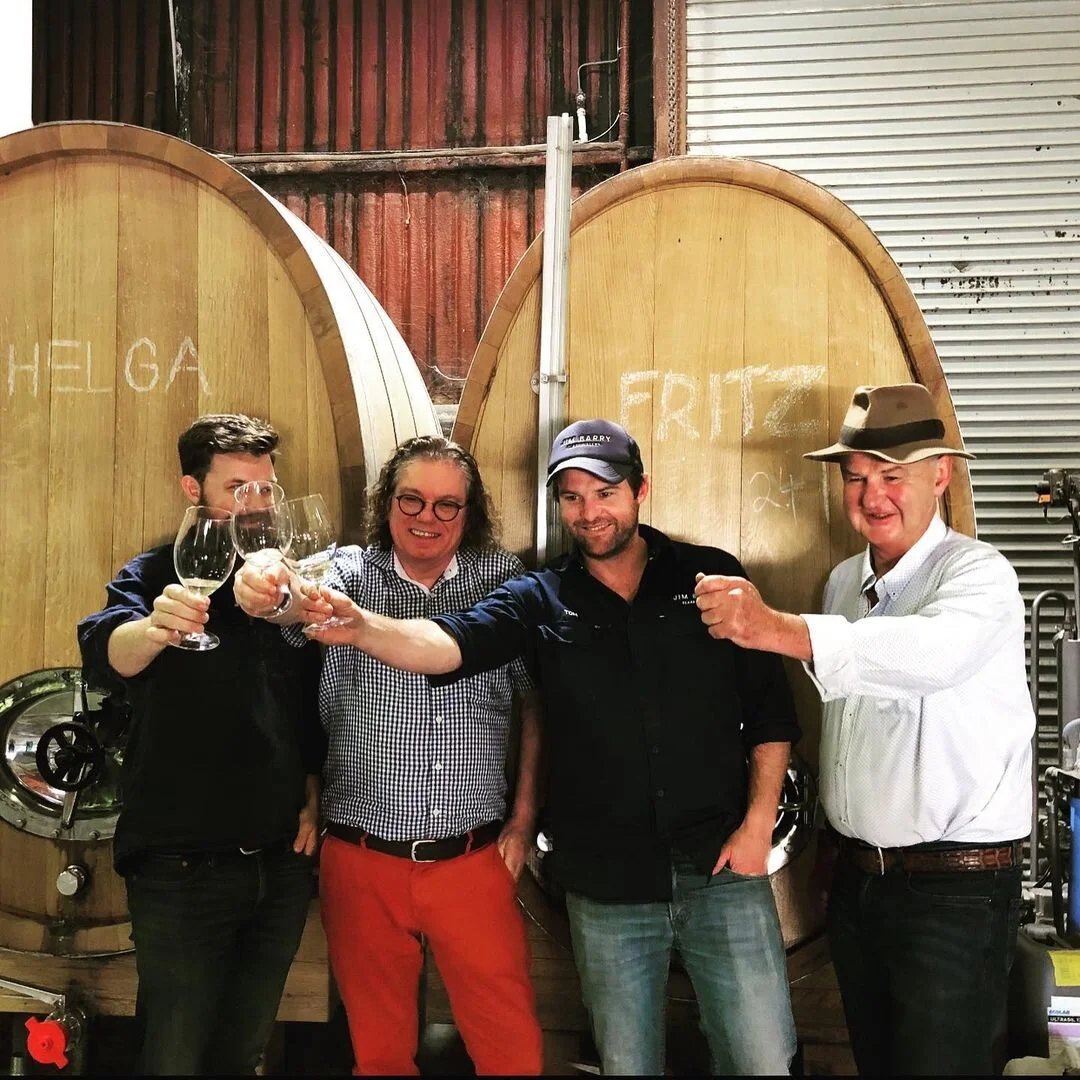
Jim Barry (far right) with Ernst Loosen flanked by Sam and Tom Barry (l-r)in front of the Wolta Wolta barrels

Jim Barry (far right) with Ernst Loosen flanked by Sam and Tom Barry (l-r)in front of the Wolta Wolta barrels

The Florita, Jim Barry 2017

Sam Barry praised the Florita Vineyard for being a famous site, although only 5% of it (the best block) ends up in this label. Originally planted to Palomino, the vines were replanted to Riesling in 1962, all on own roots. A clay-based sunscreen is sprayed to prevent harsh afternoon sun, also helping to keep the canopy cooler and increase hang-time by two days. “Sunburn is the biggest problem for us, so we fight against TDN and have east-west rows,” Barry revealed. “We get a huge diurnal range – from 40°C down to 12°C at night when all the heat is blown out of the valley by sea breezes. We press very gently, getting 400-450 litres per ton, as we don’t want to lose acid.” The 2017 is a wine of tremendous drive and purity with zesty acidity and notable intensity of lime fruit. It is taut and beautifully focussed, with a very long finish. 12.5% abv

The Florita, Jim Barry Cellar Release 2013

The Florita 2013 is starting to show what makes this wine unique. The magic of aged Australian Riesling is that it takes on a toasty marmalade character, which this wine has. With a pH of 2.9-2.95, there is ample acidity in this wine to allow it to age for much longer as well as power of fruit. No TDN notes – Barry says these are only seen in hot dry years. 12.3% abv

Wolta Wolta LoosenBarry Dry Riesling 2017

The fruit for this collaboration between Barry’s father, Peter, and Ernst Loosen came from an area of the Clare Valley known as ‘Wolta Wolta’ (the Aboriginal for good water).  “Dad and Ernie got on like a house on fire when they first met in London in 1995, and became good friends,” Barry said. “The most exciting thing about this project, which the two of them dreamt up at the 2015 Riesling Convention, is that it shows you can produce Clare Riesling in another way. Having it sat on full lees for two years has built complexity, texture, weight and mouthfeel that that no one has really seen in dry Australian riesling.” Fermented with indigenous yeasts, the wine was matured in large neutral oak (a  3,000-litre ‘Fuder’ cask). It has 7g/l of residual sugar (compared to 2g/l in Florita). “For me, it’s a very interesting experiment and style of wine,” Loosen commented. “This longer ageing gives a beautiful charming character.” 12.5% abv

Jean-Frédéric Hugel from Famille Hugel, tasting new dry Riesling from tank

Jean-Frédéric Hugel from Famille Hugel, tasting new dry Riesling from tank

Hugel Classic Riesling 2019

“What I want to do is show you varietal and terroir expression with these three wines,” Jean-Frédéric Hugel declared. “So we must taste the entry level and most expensive wines. In Alsace, we have very very little slate, unlike the Mosel, and lots of everything else. The mosaic of our soil has allowed us to grow Riesling in very different styles and profiles. The idea with the Classic is to show a benchmark. It’s from a blend of various soils in Alsace – predominantly granite & limestone, a tiny bit of slate and a fair bit of marly soils and sandstone. The clay content in marl gives fleshiness while the sandstone gives leaner wines with more aromatic profiles.” Hugel hailed 2019 as one of the top two or three vintages of the decade. 13% abv

Famille Hugel, Edition Limitée Riesling Grossi Laüe  2011

Based an old label – a re-edition of a 1950s one – this is two steps up in quality from the Classic. “The fruit comes from the three or four best blocks of the 12 we have in the famous Schoenenbourg vineyard, which made the reputation,wealth and fame of the town of Riquewihr. It’s what drew my family to settle in 1639, the objective being to get some Schoenenbourg. We are now the second largest owners on it, which gives us incredible choice in terms of blending.”  The 2011 vintage was a warm one, helping to explain the 14% abv. Full-bodied and rich, it is dry with bright acidity as well as both earthy undertones and a streak of salinity. Almond aromas precede ripe white peach and fresh lemon notes. A stunning wine. 14% abv

Famille Hugel Schoelhammer Riesling 2010

“Each of our 220 vineyard blocks has a name,” Hugel continued, “and one – the Schoelhammer – was nearly always more accomplished in terms of depth, concentration and mouthfeel, as well as having personality and ageing potential, so we thought let’s bottle it. This is built for the long-term, with 2010 the perfect meeting between the old times, when we picked in October, and warmer climates that allow for consistent quality.” Spicy with candied fruit and mineral crushed stone notes, this has power and structure yet vibrancy. Deep and earthy, this is so complex with a long life still ahead of it. “In the family, we like a minimum 20 years ageing for our single vineyard wines,” Hugel confessed. 13% abv