David Guimaraens of Fladgate

Fladgate’s Guimaraens on ‘idiocy’, declarations and Taylor’s Sentinels

2024 looks like being declared a classic port vintage – the first since 2018 – according to David Guimaraens, the celebrated technical director and head winemaker for The Fladgate Partnership (TFP), owners of Taylor’s, Fonseca and Croft. Geoffrey Dean met up with him over lunch to talk about the thinking behind vintage declaration and taste the 2022s including a new port called Sentinels, and one of a number of new still wines that Fladgate is investing heavily in.


25th January 2025 by Geoffrey Dean

The decision will not be taken before spring 2026, but there may potentially be glad tidings for vintage port devotees. No ‘classic’ vintage has been declared by the port houses since 2018, but David Guimaraens, the celebrated technical director and head winemaker for The Fladgate Partnership (TFP), owners of Taylor’s, Fonseca and Croft, considers the outstandingly good 2024 harvest to have sufficient promise to be declared a classic in 18 months time.

Guimaraens, several generations of whose family have long occupied key positions in the Portuguese port industry, was in London to show TFP’s single quinta ports from the 2022 vintage - Taylor’s Vargellas, Fonseca Guimaraens and Taylor’s Sentinels (a new release). More on them later, but first to the question of vintage port declarations and the huge growth in demand for tawnies.

The years 2015-18 brought back-to-back declarations in the Douro for the first time in over a century. “We had a great run in those four vintages,” Guimaraens mused. “A couple of port houses declared 2015 as it was very, very fine. We declared in ’16, ’17 and ’18 as all three had the combination of quality and longevity you need for a great vintage port.”

“The ‘16s are some of the finest, purest ports I’ve had - not as big in structure but really voluptuous in fruit. ’17 was the opposite and similar to 1945 - a very hot year which produced more aggressive tannins. So ’17 was massive. ’18 was a mixture of the two. In the years after, ’19 made very elegant ports but not big; ’20 we didn’t do anything, including single quintas, as they were overripe brutes; ’21 was wet and diluted, and ’22, one of the driest years in last 20, didn't have the structure for us to declare a classic.”

Non-vintage port years, though, are a boon for the production of tawnies. The stats for the huge increase in demand for tawnies make interesting reading, for Guimaraens revealed that in his first year back in Portugal in 1990, after a five-year sojourn in Australia, Taylor’s sold 20,000 litres of their 20-year old tawny port. Already this year, sales have hit 160,000 litres.
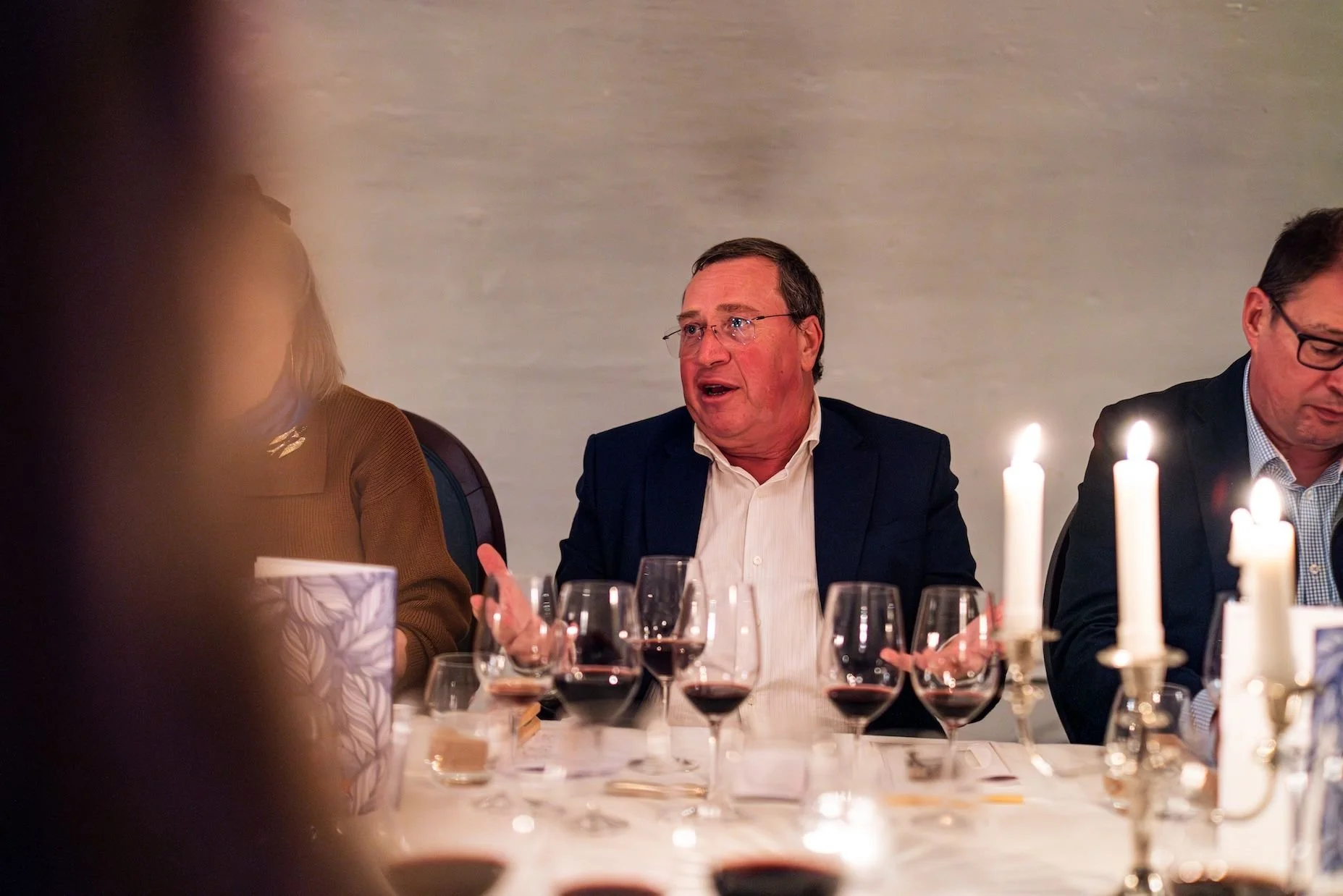
"We need to readjust ourselves as businesses,” David Guimaraens, London, November 2024

“The good thing is that you can turn imperfect ports into perfect tawnies,” he continued. “And we have a much healthier industry if we have two great styles of port recognised rather than all vintage or nothing. We have incredible stocks of tawny port. In between vintage declarations, there’s a whole world of tawny port that is capturing the attention of drinkers. To bring 50-year old tawnies or 80-year old VVOP to the market is pretty extraordinary, and that’s a very important sign.”

That importance relates to what Guimarens calls the ‘turbulence’ of the last few years.

“In the port trade we are going through major restructuring,” he added. “Although volumes are shrinking in the port industry, we're also going through a phase where we have never sold as much special category premium port. So we must be careful how we interpret a shrinking industry. Over the last 20 years the Douro has changed from a port wine producer to a region of port and very fine Douro table wines. So we need to readjust ourselves as businesses.”

That readjustment saw TFP acquire last spring its first vineyards in the Douro for table wine production. The Quinta do Portal estate joins other TFP wineries in the Minho, Dao and Bairrada wine regions. “It was an economic necessity to go into Douro table wine,” Guimaraens explained.

"Although we’re magical as a country, we’re idiots in the way we manage ourselves. This year we were only allowed to transform under the Douro Valley quota system one third of our production into port wine.” It means that the remaining two-thirds of fruit from TFP's 500 hectares of port vineyards can only be used for table wine production.

Tasting the new ports

Croft 1970 Vintage Port

From a very hot year, so not a lot of fruit but stunning richness. A great old port from a house acquired by TFP in 2001 whose venerable Quinta da Roeda estate Guimaraens rates extremely highly.

Principal Grand Reserva Red 2012

TFP’s new Bairrada estate on limestone soils with a maritime climate (acquired August 2023). Super-premium blend of Touriga Nacional (50%), Cabernet Sauvignon, Petit Verdot and Merlot that retails in Portugal for €110. Big, bold complex fruit with fine, soft tannins and concentrated richness. TFP CEO Adrian Bridge thinks Principal has the potential to become “the Vega Sicilia of Portugal.” He could be right.

Taylor’s Vargellas Single Quinta Vintage Port 2022

From FTP’s flagship estate, Vargellas. A superb single quinta port with violet and herbal aromas, notes of woodland fruit and blackcurrant. Firm but well-integrated tannic backbone to the wine which has notable elegance, balance and poise. RRP £44

Fonseca Guimaraens Vintage Port 2022

A blend of three Fonseca quintas - Panascal, Cruzeiro and Santo Antonio. Has the same quality of a Fonseca classic vintage port but not the longevity. Aromatic opulence with intense voluptuous notes of cassis, blackberry and wild strawberry fruit with hints of spice and dark chocolate. Silky tannins. RRP £39.

Taylor’s Sentinels Vintage Port 2022

A new release but with the same philosophy as the Fonseca Guimaraens. A blend from Taylor’s historic properties in and around the Pinhao Valley. Lavender and herbal aromas with rich notes of damsons, dark plums, blackcurrants and black cherries. RRP £40.

Fonseca 1992 Vintage Port

Majestic vintage port with a cornucopia of notes of old leather, tobacco, spice, black fruit and chocolate. The first classic year declared for seven years - an unusually long gap.

Top 10 wines of 2024

Best wines of 2024: How Geoffrey Dean's top 10 have a southern bias

Another in our special series of restrospective tastings as our key wine reviewers share the wines that made 2024 an exceptional year for them. Geoffrey Dean is a wine writer who spends a good deal of the year in the Southern Hemisphere so it is no surprise to find that the majority of his Top 10 wines of 2024 are from South America and South Africa, with just a few Europeans thrown in for good measure.

31st December 2024 by Geoffrey Dean

Capensis, Silene Chardonnay 2020, WO Stellenbosch, 14% abv

A blend of top-quality fruit from four vineyards in Stellenbosch, including the prime 640m Fijnbosch site in one of the district’s highest wards, Banghoek. The idea for it came from owner Barbara Banke, the American proprietor of Jackson Family Wines who, according to winemaker Graham Weerts, ‘fell in love’ with Stellenbosch Chardonnay. It is the only grape Capensis produce. Attractive citrus allure with silky texture from lees contact. Elegant and fresh with a touch of salinity as well as spice and toasty notes from 30% new oak.

Cederberg, Nieuwoudt Five Generations Chenin Blanc 2022, WO Cederberg, 13.5% abv

As good a Chenin Blanc as you will find in South Africa. David Nieuwoudt, whose grandfather Pollie planted what are the highest vineyards in the Cape Winelands (at over 1000 metres) in the spectacular Cederberg Mountains, is a master winemaker of this grape. This was the first year that concrete eggs were used for some of the must (10%), boosting richness in the wine’s tantalising texture. Elevage for eleven months in oak (20% new) adds further structure. Whole-bunch pressed and barrel-fermented with wild yeasts, this western Cape classic has huge concentration, complexity and length.

De Martino, Viejas Tinajas Tinto 2022, Guarilihue, Itata, Chile, 13% abv

An elegant single varietal Cinsault from dry-farmed vines planted in 1975 in Itata, southern Chile. Fermentation and ageing for 8 months in clay vats (tinajas) that are over 100 years old. 8% whole bunch (in one tinaja) adds some complexity, grip and structure. Glorious red fruit, medium body and suave tannins make a second glass - or bottle - very appealing. Available in UK through Enotria&Coe, De Martino’s main British partner.

Humberto Canale, Old Vineyard Riesling 2024, Rio Negro, Argentina, 13.3% abv

Wonderful Patagonian Riesling from vines planted on own roots in 1937 (La Morita vineyard). Phylloxera has never reached this arid, semi-desert region of year-round sunshine and low disease pressure. Real intensity to the super-clean lemon and white peach fruit, which was harvested with a pH of 3.0. Steely minerality from flood-irrigated Rio Negro, whose source is in the Andes. Available in the UK through the Great Wine Co (£22).

Leonardslee, Brut Reserve 2021, Sussex, England, 11.5% abv

The first vintage of Leonardslee, owned by the Streeter family, and what a debut! Top-notch traditional method English sparkling wine that spent up to 30 months on the lees, and has a dosage of 7.5g/l. 70% Chardonnay, 20% Pinot Noir, 10% Pinot Meunier. Very high levels of acidity (TA 8.9g/l) led to 100% malolactic fermentation. Some reserve wine from 2020 used. Vibrant yet elegant with green apple notes, grapefruit zest and hints of yeastiness and brioche. Fine mousse with lovely mouth-filling texture and impressive length. Hats off to Benguela Cove head winemaker, Johann Fourie, who flies in at key times from South Africa to mastermind production at the estate just outside Horsham.

Pommery, Apanage Brut 1874, 12.5% abv

Only just released in November 2024 to celebrate the 150th anniversary of Pommery’s creation of the first ever Brut Champagne in 1874. An ‘Apanage’ was a grant of land or revenue by a French sovereign to a member of the royal family, and was therefore evocative of distinction. This is a blend of three vintages - 2018, 2015, 2012 - all spending four years on the lees. Fruit (around a third each of Pinot Noir, Chardonnay and Pinot Meunier) came from 17 villages. A persistent mousse with delicate aromas of white flowers and orange blossom give way to notes of citrus fruits, pear and apricot. These gradually open up to more complex, autolytic flavours of honey, almond, hazelnut and brioche.

Quinta S.Joao Batista, Reserva de Biodiversidade, DO Tejo 2016, Portugal, 14% abv

A blend of Touriga Franca (70%) and Alicante Bouschet (30%) from the Tejo denomination north-east of Lisbon. Elevage in second and third fill oak for six months. Very appetising red fruit with lots of intensity as well as soft tannins and a lengthy finish. Great value mid-market wine (€16 retail) from a lesser-known region of Portugal that deserves, and looks set for, greater recognition.

Santa Rita, Casa Real Cabernet Sauvignon 2022, Maipo Valley, Chile 14% abv

Flagship Casa Real label of Santa Rita from their low-yielding, old Cabernet vines, planted in 1978 to a density of 3,800 plants per hectare on alluvial soils in Alto Maipo. Veteran winemaker Andrés Ilabaca has crafted a princely Chilean Cabernet with majestic black fruit, earthy tannins and a tobacco kick. Oak (30% new) is well-judged. Extraction also neatly effected, with pump-overs but no punchdowns (nor cold soak). Fruit 100% de-stemmed. Complex with great concentration and a long life ahead of it.

Sunal, Icono Malbec 2017, DO Valles Calchaquies, Argentina 14.5% abv

Top-class extreme altitude Malbec from the far north of Argentina, produced by leading winemaker Agustín Lanús. A blend of micro-terroirs from three provinces in the Calchaquí Valley - Salta, Tucumán and Catamarca - with altitudes ranging from 2,100m to 2,750m. Deep purple, full-bodied and multi-layered, the wine is a complex cornucopia of dark fruits - black plum, blackberry, black olives with balsamic and spicy notes.

Vinos Lof, Syrah 2022, DO Maipo Andes, Chile 13.5% abv

Vinos Lof, a 3-hectare boutique winery co-owned by Perez Cruz winemaker Germán Lyon and wife Francisca Gaete, is one of nine that have formed a new association of small-scale Alto Maipo producers called MaipOrigen. To qualify, each had to be organically-farmed and family-owned, with a maximum annual output of 50,000 bottles. Lyon, one of Chile’s best winemakers, has fashioned a beautifully balanced wine with soft tannins, seductive red and black fruit with herbal and pepper notes. Minerality from volcanic soils and freshness from cool nights. ‘Lof’ is the indigenous word for ‘clan.’ Available in the UK through Virgin Wines (£24.99). The other eight members of MaipOrigen are Caviahue Wines, Viñateros de Raíz, Chateau Potrero Seco, Viña Los 3, Mujer Andina Wines, Los Quiscos, Rukumilla and La Viña del Señor.


Newfound Wines, California

Newfound Wines – connected to both the land and the universe

California’s Newfound Wines is the latest discovery of Geoffrey Dean who advises to ‘snap them up while you can’. Taking an individualistic approach, Matt and Audra Naumann make authentic wines that contain a naturally rugged edge and, most importantly, capture the voice of their unique vineyards. They also over-deliver for their price point which is a rarity on the West Coast. “We view farming as a connection not just to the land but to the universe, respecting that nature is in control and understanding that our role is simply to listen and react.”

6th December 2024 by Geoffrey Dean

We all love to stumble across a winery previously unknown to us whose wines really hit the spot. It will invariably have been ‘found’ by others before you (in this case by Jeroboams' Martin Tickle) but nothing quite beats a personal discovery.

Happy to report I have just made one in the aptly-named Californian boutique winery, Newfound Wines, which is situated in the town of St Helena, 18 miles north of Napa. Winemaker Matt Naumann, and fellow co-owner, his wife Audra, flew into London in October to see Jeroboams, their UK importer, and made a big impression with the eight labels available for tasting.

Naumann does not make huge quantities of wine – the pair have just six acres of their own under vine although they do buy in some top quality fruit from select growers they admire. The Newfound range is so good that the advice is to snap it up while you can, whether on/off-trade or private client

Jeroboams gets small allocations of each wine, although Naumann revealed that the 2022 vintage of its Gravels Red label is its single largest bottling at 690 cases, and “that there's plenty of room within our inventory to offer more to the UK.”

The fruit for the just-released Newfound Gravels Red, California 2022 (65% Grenache, 25% Carignan, 10% Mourvedre) comes from the Mendocino and Napa counties (qualifying it for North Coast AVA), but labelled under the broad California AVA. That way, producers can over-perform for the price which, at £33.95 RRP, is very good value for the quality. Seductive red fruit, herbal and spicy notes along with vibrant freshness and silky tannins combine to give this intensely aromatic, medium-bodied wine beautiful balance (14.1% abv). It has notable length too.

Audra & Matt Naumann

“This is our ‘village’ wine that we want to over-deliver,” Naumann declared. “It’s about the sum of all the parts. Most of the Grenache is from the Cemetery Vineyard, which has young dry-farmed bush vines – you don't see that very often in California. They were planted in an 18-inch layer of gravel, all run-off deposits from the coastal range. Carignan plays an important role in this, although it’s not in the blend every year, as it gives a bit of spine. It’s aged in 68-hectolitre casks mainly.” The excellent single varietal Benchland Carignan from vines planted in Mendocino County 1942 was aged in concrete.

Audra Naumann, who handles marketing, PR and sales, revealed that the Gravels blend has already sold very well in the UK, with an even split between the channels, but Jeroboams’ Marloes Klijnsmit professed the company is keen to sell more to the on-trade. And it is the sort of wine that should have widespread appeal to restaurants, bars and clubs alike.

In contrast to the young Grenache Gravels vines, the 2022 Newfound Chenin Blanc, Henry's Vineyard, Napa Valley comes from vines dating back to 1942 at the base of Howell Mountain. The three acres there are among only seven planted to Chenin Blanc in the whole of Napa County. Texture, intensity and glorious freshness were hallmarks of this superb expression of the varietal.

Equally impressive was the 2022 Newfound Chardonnay, Placida Vineyard, Sonoma Coast. From very low-yielding vines (1.5 tons per acre) grafted over to Chardonnay in 2019 by grower Chuy Ordaz just outside the town of Graton, this underwent neither malolactictic fermentation nor filtration. Interestingly, like the Chenin Blanc, it saw fermentation and elevage in 100% new oak (500-litre puncheons or 600l demi-muides). The oak has been immaculately judged.

“The Chardonnay came from the southern part of the Russian River Valley, which is much more interesting,” Naumann said. “In a cooler part right by a cold pocket called Green Valley. Chardonnay does very well there, holding onto its acidity well even in a hotter year like ’22 when its pH was 3.35. In both ’21 and ’23, the pH was 3.09.”

Matt and Audra Naumann at the Newfound Wines tasting, London, October 2024

The width of the diurnal range on the Naumanns’ own property – Hill View in the Sierra Foothills at 2100 feet – means that acid retention is not an issue for its Grenache vines there. A cooling coastal breeze off the Pacific is also beneficial. When the couple bought the ranch in 2106, the neglected vines were grubbed up, with the replanted ones farmed organically in line with their nature-led philosophy.

“We view farming as a connection not just to the land but to the universe, respecting that nature is in control and understanding that our role is simply to listen and react,” Naumann declared. “We endeavour to take an individualistic approach and raise authentic wines that contain a naturally rugged edge and, most importantly, capture the voice of our vineyards.”

The magical vineyard at Shake Ridge Ranch

The Grenache planted at Hill View and Shake Ridge Vineyards on what are ideal soils for the varietal – 100% decomposed granite – certainly does ‘capture the voice of the vineyards’. Any rugged edge only added to its complexity, with its tannins tactile yet polished. With no new oak (only third fill or older) employed for any of the reds, all of them spoke of their terroir, with a mineral character evident from the Grenache and Syrah. “That’s such a thumbprint of the wines,” Naumann mused. “So much clarity and transparency.”

Thanks to the fact that Naumann is, as he puts it, “very conservative and moderate with sugar levels at picking,” the six reds tasted were all between 12.5% and 14.1% abv. “All my reds are whole-bunch pressed,” he revealed. “Adding whole makes sense as we’re not trying to make overly fruit-driven wines. I like the savoury side stylistically – it lifts aromatics. I don’t do punchdowns, just pumpovers with the Mourvèdre. Wild yeasts for both white and red fermentation.”

While Newfound’s annual production is low - between 3-5,000 bottles - exports to Canada, Denmark, Sweden, Belgium and the UK are valued.

“We’re thoughtful where we're positioning ourselves in the world,” Audra said. “About 40% exports diversifies your risk. The New York market is pretty challenged right now, as is California with consumption down thanks to a challenging economy, high interest rates and more attention to health. The ethos of our brands resonates more with the next generation wine drinker.”

Matt added: “Regarding our production, the volumes have increased over the years and continue to do so. While the vineyard designates tend to be limited in supply, additional quantities are also available from each of the Placida Mourvèdre & Grenache bottlings tasted. Unfortunately, the Chenin Blanc and Chardonnay were quite scarce from the 2022 vintage, so whatever Jeroboams has on hand would be it for the time being. However, we expect more will be available with the next vintage release (2023) in the early part of 2025.

The UK is an important part of our sales strategy as we look to continue to develop our presence. We absolutely love the professionalism within the wine community and feel that our style is well suited for the market.”

Meanwhile, visitors to St Helena will now find a cellar door that the Naumanns started in 2022. “We’re doing as we hoped,” Audra said. “The Grenache gets snapped up as the maximum we make of anything is 120 cases bar the Gravels. With quite affordable price tags, people ask ‘why aren't your wines more money?’ But we don't want to go down that route…we want to make fine wines that are priced fairly. We want you the drinker to be really happy.”

Having tasted the wines, that should be a given.

The wines available through Jeroboams

2022 Newfound Chenin Blanc, Henry's Vineyard, Napa Valley 13.5% £55

2022 Newfound Chardonnay, Placida Vineyard, Sonoma Coast 13.5% £55

2022 Newfound Gravels Red, California 14.1% £29.95

2022 Newfound Grenache, Placida Vineyard, Sonoma Coast 13.7% £55

2022 Newfound Mourvedre, Placida Vineyard, Sonoma Coast 12.5% £55

2019 Newfound Shake Ridge Grenache, Amador County 13.9% £46

2019 Newfound Shake Ridge Mourvedre, California 14% £46

2019 Newfound Benchland Carignane, Mendocino County 13.5% £35.5


Bibendum's 2024 Bordeaux Collection

How Bibendum is bringing Bordeaux back to its rightful place

Times may have been challenging for Bibendum since the first half of 2023, but what was a largely new management team at the autumn Cellar Tasting of its Bordeaux Collection were full of optimism for the year ahead. The grandeur of Lancaster House also tends to add some feel-good factor as well as attracting a big turnout, with many lured no doubt by a Baron Philippe de Rothschild masterclass and the presence of Sandrine Garbay, the former Yquem winemaker now in the role at neighbouring Sauternes estate, Château Guiraud. Geoffrey Dean tasted the wines, met up with the new producers in the Collection, and heard about Bibendum's other educational innovations.

30th October 2024 by Geoffrey Dean

This latest Cellar Tasting event was a selection from Bibendum’s pioneering Bordeaux Collection which, as a partnership between Bibendum and leading Bordeaux estates, is the first of its kind and shakes up the selling of Bordeaux fine wine to the on-trade and independent retailers.

First launched in 2020, the Bordeaux Collection has been hugely successful, growing from an amazing initial list to one that now features some of Bordeaux’s most famous and prestigious estates, arguably making Bibendum the home of Bordeaux for the hospitality industry in the UK.

Through this collaboration, Bibendum customers are now able to buy an ongoing selection of mature wines with perfect provenance directly from Bordeaux chateaux cellars, ranging from Cru Bourgeois to First Growths, at extremely competitive prices.

Turning the tide

Rob Sandall, Bibendum’s new sales director for England and Wales, was candid in his assessment of the distributor's predicament.

“I’ve been here three months, and we have some great wines and some amazing people, and frankly they’ve had a tough time over the last 12 to 18 months,” he said. “We’ve had some challenges with service and my job’s been sorting that out. We’ve upgraded our IT system, and we moved from Park Royal to a state-of-the-art depot on the outskirts of London, at the beginning of this year, which is world-class and has increased capacity for us to better service our customers. Our vision is all about quality products, reputation and good quality customers. Although we’ve had some customer attrition, our customer numbers are ahead of where we were last year. After three months, I’m pretty happy where we’re going.”

Lancaster House - the right setting for such prestigious chateaux

Another new recruit, Yann Bourigault, the director for business development and key accounts in London and the south-east, predicted 2025 will be an 'amazing’ year for Bibendum.

“We have a new Bibendum - that’s the bottom line,” he declared. “New management, new people and, to some extent, a refreshed portfolio. We’ve had some producers leave but this has opened the door for new producers to join, some of whom are coming on board in the next few months. In terms of service, we have a new warehouse and a fleet of new electric vehicles and our vision is to be a benchmark for London. As a newcomer to Bibendum, you discover all the resources the company has. Everything is in place for us to succeed next year. We’re getting there in terms of hiring, and we are on track to open lots of new accounts next year, because we have the portfolio, and on top of that, the logistic resources.”

New additions to the Bordeaux Collection

A new addition to the company’s Bordeaux Collection is Château Haut-Batailley, whose commercial director Pierre-Louis Araud, was on hand to show both the fifth growth’s grand vin from 2016 and its appealing second label from 2019. He explained why the latter is named Verso de Haut-Batailley.

“Verso means the other side of the page, or the grand vin,” he said. “It is a fruit-forward wine while still having the structure of a Pauillac.” Like the grand vin, it was 70% Cabernet Sauvignon, with the balance Merlot and a dash of Cabernet Franc.

From Pomerol, meanwhile, Monique Bailly-Laborde, wife of Château Clinet winemaker, Ronan, was at Lancaster House to show their elegant grand vin Clinet 2014 (90% Merlot, 9% Cabernet Sauvignon, 1% Cab Franc). “This was the first year we vinified in stainless steel rather than wooden vats,” she said. “I really feel that from 2014, the wine had greater purity than before.”

Sandrine Garbay - making changes at Château Guiraud

"Semillon is more the identity of what is dry Sauternes": Sandrine Garbay of Ch Guiraud

In luring Sandrine Garbay away from Yquem after nearly three decades as winemaker there, Château Guiraud signalled their lofty ambitions, which include the construction of a hotel on the estate in 2025, with completion due by 2027. The cellar will also be renovated. Garbay’s first vintage there was 2022, and she immediately made her mark by reversing the cepage of the dry white wine, which had been 70% Sauvignon Blanc and 30% Semillon.

She explained why the latter varietal now comprises 70% of the blend.

“We have a really nice terroir which historically was producing really nice dry white wine, but Semillon is more the identity of what is dry Sauternes,” she said. “We want to make something different from what is made in Pessac-Leognan for example. We have to highlight the Semillon I think, and I am very proud of this vintage of 2022. Semillon has such a big potential for ageing.”

With global sweet wine consumption in decline, dry white production in Sauternes has taken on increased economic importance for the appellation’s producers.

“The idea of the dry white is also to show another expression of the terroir of Sauternes, and thanks to that we can go on with the production of sweet wines,” Garbay continued. “It’s a question of a balance between economic concerns and our identity and skill as sweet winemakers.”

As an icon of sweet winemakers, few can emulate Garbay for skill. On her arrival at Guiraud, she began fine-tuning vinification, introducing wild yeasts for fermentation. ”It has has made a big difference,” she mused. “More complexity, and easier to stop them as they produce not too much alcohol, and less SO2 is needed. Thanks to that, a really more enjoyable wine.” She estimated that 30-40 mg/l less sulphur dioxide is required - around 250 mg/l. Interestingly when she first started at Yquem, she revealed SO2 levels were as high as 380 mg/l.

Beautifully balanced wines have always been Garbay’s calling card.

“I am totally fond of very well-balanced Sauternes wine,” she sighed. “I am totally convinced that the future of sweet wines from noble rot is not to have too much sugar, and to put balance between the sweetness and the freshness. The residual sugar levels don’t change much - around 130g/l - but in the harvests of ’22 and ‘23 we could have had very high levels. I don’t want to go this way. There was less acidity than before, so that’s why we have to be careful with the balance between sugar and flavours. We can preserve the fruitiness of the grapes by decreasing the times of racking for example.”

While producers of still wines have been battling against the effects of global warming, Garbay thinks it has benefited Sauternes.

“It has not really been a problem for sweet wine producers,” she professed. “Until now it’s been very positive I have to say as we had more consistency in the sweetness, in the noble rot process. It was easier to concentrate the sugar. The risk is that one day we have less humidity for the development of noble rot, but that’s not the case at the moment. This year, for example, we had a lot of humidity and beautiful, very intense, noble rot. We’ve made three tris till now but will do four. The most we did at Yquem was seven in 1997. That was not possible before at Guiraud but now I’m able to do seven as we have 80 pickers which is quite huge.”

Introducing The New Bordeaux School

Garbay will talk about climate change in one of four online masterclass tastings Bibendum has set up on successive Mondays, starting on November 18 as part of its New Bordeaux School. Haut-Bailly, Lynch-Bages and Beychevelle will make up the quartet, and will each lecture on different themes, including viticultural changes, technical innovation in the winery and sustainability. The idea came from Valeria Rodriguez, Bibendum’s director of fine wine and prestige sales.

“At Bibendum, we've always been pioneers in education, winning Wine Educator of the Year at this year’s IWC,” she said. “I proposed to our training department to come up with a new Bordeaux school. We will ship samples to all attendees, who will be sommeliers or have, as a minimum, WSET level 3. It’s very exciting and the producers are very happy. I do feel Bordeaux has lost a bit of ground, particularly in the on-trade, and the goal for Bordeaux through initiatives like this is to come back to its rightful place.”


Kaesler London tasting, July 2024

How 2020 Old Bastard Shiraz shone at tasting with Kaesler’s Tim Dolan

Having just appointed Jeroboams as its UK distributor, the Kaesler winemaking team of Tim Dolan (head winemaker) and Nigel van der Zande (head of viticulture) were in London to show off the new range of Barossa wines to The Buyer’s Geoffrey Dean. Subjects of conversation included their wealth of old vines, exciting developments in the winery and their organic and regenerative farming plus a sneak preview of an exciting new Cabernet Sauvignon called ‘Age of Light’; not forgetting, of course, the new 2020 Old Bastard Shiraz, named after some bush vines that are up to 129 years old.

4th September 2024by Geoffrey Dean

,The oldest surviving Shiraz vines in the world are thought to have been planted in 1843 at Langmeil in the Barossa Valley, only a few kilometres from the Kaesler vineyards just outside the town of Nuriootpa. Their first vines were put in exactly fifty years later in 1893, earning them royalty status within the region. And the latest vintages of their wines that Jeroboams will be bringing to UK shores this autumn are nothing less than princely.

Kaesler’s chief winemaker, Tim Dolan, jetted in from South Australia in mid-summer to show a striking sextet of wines. Ironically, he could only take the credit for one of them - the Old Vine Semillon 2023 - as he was not not recruited until September 2022. The five red wines he brought with him were all produced between 2018 and 2021.

Kaesler head winemaker Tim Dolan

It was something of a coup for Kaesler to lure the talented and highly affable Dolan from Peter Lehmann in nearby Tanunda, for he comes from a family with an impeccable winemaking pedigree. Grandfather Bryan won the first ever Jimmy Watson Trophy, the most coveted award for a wine in Australia. That was back in 1962, and Tim’s father, Nigel, enjoyed an equally distinguished career himself winning the same trophy in 2003 at Saltram, where Tim grew up. In 2018, Tim, then 33, won the prestigious ‘Dux’ award of the Len Evans Tutorial, beating 11 other young Australian winemakers in a week of blind-tasting and assessment by their older peers.

That took place in the Hunter Valley, which was fitting given Dolan’s love of that region’s style of Semillon. At Peter Lehmann, he followed the Hunter’s practice of picking early at no more than 11 Baumé before fermentation in tank and bottling straight afterwards. This philosophy he took with him to Kaesler with the 2023 Old Vine Semillon coming in at 11.2% abv with a very low pH of 2.98. Interestingly, the fruit from vines planted in 1962 is a field blend of 90% Semillon and several other white grapes such as Palomino and Pedro Ximenez.

“It’s just six rows of vines over maybe half a hectare that gives us about 240 dozen,” Dolan revealed. “We picked it in February but, if it’s really dry, we might pick late January. All the fruit went in and was co-fermented. But 2023 was very similar to 2011 - a cool and wet vintage. The 2011s are stunning right now - honeyed with some toast and a little bit of lanolin.”

The 2023 promises to be a cracker, either best drunk within 2-3 years or left until after 2030 to avoid Semillon’s renowned dumb mid-life phase.

The majority of Kaesler's vineyards are made up of old vines

Kaesler, though, is best known for its quartet of Shiraz labels, but before tasting them, Dolan was keen to highlight the quality of the ‘Age of Light’ Cabernet Sauvignon 2018. This is the first vintage of this label, which is made in very small quantities and comes from the best fruit on several blocks, the oldest of which was planted in 1970. Because of the proliferation of Eutypa trunk disease (aka ‘Dead Arm’), yields are tiny – just two tons per hectare.

“This has been a bit of a journey for Kaesler in terms of Cabernet, which was a kind of afterthought,” Dolan said. “In 2009 when Matthew Jukes tasted through in the Barossa, he tore the wines to shreds. He said the Cabs were too ripe, over-extracted and not varietal. So it was decided to pick a lot earlier. It's an extraordinarily limited production of 200 cases, and I’m most excited about it. Cabernet is the second most planted varietal in the Barossa, and if done well, can be exceptional. You’re the first to see it in the UK. It was nicknamed the Old Bastard Cab but no one in the company knows where the name ‘Age of Light’ came from. Someone must have just blurted it out and we ran with it. But it’s a great name.”

Talking of iconic names for labels, ‘The Bogan’ has attracted a cult following in Australia. The Aussie vernacular for a rough, uncouth red-neck, typically unshaven with a mullet, it is hardly reflective of what is a highly polished wine. But the slang appeals to the national psyche, breaking down barriers and drawing numerous consumers to the cellar door who want to taste and buy it, and nothing else. While the 2020 was “a gem from a really tough year” in Dolan’s words, the 2021 was a great vintage, the best Bogan that has ever been made according to Stephen Dew, senior winemaker at Kaesler since 2002. The fruit comes from a blend of estate parcels planted between 1899 and 1965.

Kaesler’s Old Vine Shiraz 2020 is made from three estate vineyards that are 52, 72 and 124 years old. The difference between this wine and its Alte Reben (German for ‘old vines’) Shiraz 2018 is that the fruit comes from vines planted in 1899 at the company’s Marananga vineyard 8km from the winery, where the soils are different.

“There’s something special about the Alte Reben block, which produces a very elegant wine, not a ball-buster,” Dolan declared. “The vines were bush vines but they’ve been trained and look like they’ve been tended for every day of their lives. By contrast, the Old Bastard vines look like they’ve been let go for a while. The soils aren’t as generous as the Kaesler soils, which are a lot deeper and more fertile although both are sandy loam over clay. That clay layer is very important as it definitely saves us in summer.”

The Old Bastard Shiraz 2020 is the product of 12 rows planted in 1893 that make up just over a hectare of vines sat behind the winery in Nuriootpa. Sadly, another hectare of these same ancient vines were grubbed up in the national vine pull of the 1980s.

“There’s attrition every year - you see it,” Dolan sighed. “We at least get quite large bunches as the clone is different to that of Alte Reben. In a good year, we get 5-6 tons off this block. The berries are tiny and give incredible concentration. This vintage is a gem but you need to give it some time as it’s going to develop into something pretty special.”

Special is certainly a word that could be applied to the full Kaesler range, which is notable for how well balanced the wines are. If, like most winemakers in the region, Dolan may need to add between 0.5-1g/l of tartaric acid to the reds, he has brought alcohol levels down by picking at mid to high 13 Baumé compared to 14-15 previously. He has pared back the amount of new oak used and looked to vary vessel size, with a 2,000 litre foudre recently installed. None of the wines have been fined since arriving, with only the most sophisticated form of filtration - crossflow - employed.

Credit must also go to the work done by viticulturist Nigel van der Zande, who has been vineyard manager since 2001. “Our improvement of soil health using composts has improved vine health, and we tend to see flavour at lower sugars,” he said. “This helps us to achieve more balanced, fresher wine, requiring very little acid adjustment. Our attention to sustainable, regenerative farming techniques is allowing us to produce fruit with elegance.”

These techniques include allowing mid-rows to support an increasing mix of native plants, which are largely kept down by grazing with sheep; the slashing of grasses only twice a year (between rows and under vine at the same time to reduce compaction and fuel usage); the replacement of fertilisers with an annual compost application; and minimal irrigation prompted by data from soil-moisture probes. These practices have helped lift organic soil carbon levels from 0.8% to 1.8% over the last decade. This sequestration of carbon builds the health of the soil, promising better fruit for Dolan in his quest to maintain, and lift higher still, the quality of Kaesler’s world-class wines.

So how were the Kaesler wines tasting?

‘Old Vine’ Semillon 2023

Crisp, dry and pristine with lemon, green apple and lime notes as well as hints of dried herbs and wild flowers. A delight now but its taut, crystalline acidity (7g/l TA) will allow it to age gracefully for many years. As made in the Hunter Valley style (lower alcohol, no oak influence), it should develop honeyed, toasty notes after 6-7 years of cellaring. 11.2% abv (POA)

‘Age of Light’ Cabernet Sauvignon 2018

First vintage of this beguilingly fresh Cabernet, which is only made in the best years. Beautiful blackberry, mulberry and black cherry notes with hints of leather. Seamlessly fine tannins, wonderful concentration and a very long finish. 100% new oak effortlessly absorbed, giving it structure to last many years, if you can resist it now. Underlines how good Barossa Cabernet can be. 14% abv (RRP £89)

The Bogan Shiraz 2021

Not a surprise that Stephen Dew’s 20th Bogan is, in his view, the best. An absolute ripper of a wine that is perfectly in balance: luxuriant, complex black plum and blueberry fruit with hints of dark chocolate; a full body and ample structure from 30% new oak (the balance second and third fill) for 16 months; bright acidity and spicy, savoury, ripe tannins on the finish comfortably carry the alcohol. Long with massive concentration, yet still elegant. 14.5% abv (£34.50)

‘Old Vine’ Shiraz 2020

Dense purple-crimson with luscious blue and black fruit notes with hints of chocolate, liquorice and earth spices. Cuttings from the Old Bastard vines. Aged in puncheons (40% new) for 16 months. Soft with delicate, fine tannins. 14.5% abv (£40.95)

‘Alte Reben’ Shiraz 2018

Raspberries and red plums on the nose, giving way to blueberries, bitter chocolate and spicy oak on the palate. Fruit picked in three different stages to achieve the best balance. Soft, silky tannins and ample freshness with fabulous length. Such a refined wine with so many layers. 14.5% abv (£75)

‘Old Bastard’ Shiraz 2020

Those drinkers wanting a powerful Shiraz with finesse should look no further than this graceful Old Bastard. Profound fruit depth and purity with melt-in-the-mouth tannins and a prodigiously long finish with simmering heft. Complex layers of dark plum and blackberry fruit with black forest gateau, creme de cassis, chocolate and spice. So much seems to be packed into the wine but everything is in balance. A stunner. 14.5% abv (£127)


Klein Constantia

How Matt Day makes benchmark Sauvignon Blanc at Klein Constantia

While the new Vin de Constance 2021 will attract the most media coverage for iconic South African estate Klein Constantia, this historic stickie is only one wine in winemaker Matt Day’s extensive portfolio. With the influence of Sancerre’s Pascal Jolivet, Day has been pushing the envelope on making single vineyard Sauvignon Blancs that he believes could become seen as the benchmark in quality New World SBs. Geoffrey Dean reports and tastes both the new Klein Constantia wines and the reds of Anwilka

3rd September 2024 by Geoffrey Dean

Matt Day, the winemaker for South Africa’s greatest sweet wine, Vin de Constance, likes to challenge notions. For a start, despite its typical residual sugar levels of 155-170 g/l, he does not really think of it as a sweet wine.

“It tastes almost dry - that’s the key to Vin de Constance,” he mused, during a visit to London in mid-summer when he brought with him half a dozen different vintages, including samples of not just 2022 and 2023 but also 2003.

The latest release, the Vin de Constance 2021, is certainly beautifully delicate, as well as being charmingly refined.

“It’s not a sickly sweet wine - the residual sugar is there as a flavourant.,” Day added. “It’s all about the balance between sugar, alcohol and acidity. The goal is to figure out what that is and create a sweet wine that isn’t too sweet. The whole residual sugar discussion has got to the point where the level is so consistent, and that’s because of the blending during fermentation. You start with 25 batches, and you blend it, and you blend it again and you blend it again until you have a very homogenous kind of blend which has the right sugar, and right acid, and right amount of alcohol,” Day explains.

If 2021 is a favourite vintge of Day’s, he loves the 2016 no less. The latter is also the vintage to which Jancis Robinson has given her highest marks for those tasted in the last decade. Very intense, savoury and spicy, with dried pineapple notes, it was the first vintage to be made in a brand new cellar at Klein Constantia.

Matt Day in the winery: "242 is south-facing and only ten metres away from Block 241 but we’ll pick it six weeks later. That’s terroir."

“The tanks were specially designed for Vin de Constance,” Day revealed. “Ageing was in brand new foudres of 4,500 litres. It was a hot vintage with harvesting in three weeks of March when we made 23 passes. By contrast, we made 25 in 2021, when we finished in the first week of April. It was a weird year, but with fabulous flavour and concentration.”

The 2021 was the first vintage that saw elevage of 18 months in barrels (60% new) followed by another 18 months in the foudres that were installed in 2016. The purpose of the former is, Day says, to provide ‘a fast-track route’ from primary to secondary flavours though the influence of micro-oxygenation.

Primary flavours - aromatic fermentation characteristics such as lychee and Turkish delight notes - are attractively perfumed but ‘don’t taste a terrible lot’ in his words. “But I still want to create more complexity, so then it’s into foudres where it’s a time capsule, as it prevents any further oxidation, but you’re still getting integration of oak into the wine which becomes very interesting.”

The French influence on the estate’s Sauvignon Blanc

No less important to Klein Constantia than Vin de Constance are the estate’s 42 blocks of Sauvignon Blanc, which produce outstanding expressions of the varietal. The winery makes between 125-160,000 bottles of it each year, depending on yield, with several different small-production labels in addition to the estate Sauvignon, such as Metis, Clara and Perdeblokke. Rebranding, through new labelling and a new bottle shape, has been effected.

Day is not being immodest in declaring that “my goal as a winemaker is to make an iconic Sauvignon Blanc that is the New World reference of what Sauvignon Blanc is.” For Klein Constantia is blessed with perfect terroir, as acknowledged by one of Sancerre’s leading producers of Sauvignon.

“It was after I worked with Pascal Jolivet in Sancerre that I learnt that wine is made by terroir not the winemaker,” Day said. “His winemaker Jean-Luc Soty came to South Africa for the 2013 harvest with me, and said as we were walking through one of the blocks, ‘Matt this is perfect for my style of making wine: hyper-oxidised at crush, no settling, dirty fermentation on high soluble content, with wild yeasts and a long time on the lees.’”

“In those days we were making Sauvignon like we were taught at university - very clean, lots of sulphur, inoculated yeasts, cold fermentation, very short time on the lees, get it out of the cellar as quick as possible. But we made the Metis in his style, and learnt so much from that project that we started incorporating what worked in the Metis back into the estate Sauvignon Blanc. They were made in the same way, so we had to change the style of Metis quite a bit to differentiate it.”

This change in thinking did not end there.

“We started more of a micro-vinification approach,” Day continued. “We found the three best blocks with the grapes with the most personality, almost with salinity to them, and kept those separate for the Metis. Then the other big difference was we put it in neutral oak barrels and left it there for six to nine months depending on the vintage. It just created a different texture to the wine. The estate Sauvignon Blanc remained tank-fermented and tank-aged.”

Now every single one of the 42 Sauvignon blocks is made in its own tank, having its own personality and then being blended after six months on the lees. Then you have the perfect blending process, taking a bit from this tank and a bit from that one. Fortunately, I’ve been there for 16 years now, and understand the personality of the blocks.”

The French influence on Day has been profound.

“A lot of the blocks are made like Metis - high soluble content at fermentation, about 80% of it is hyper-oxidised at crush. When you’re hyper-oxidising, you’re doing everything you’re told not to with Sauvignon Blanc, but what we’re doing is oxidising away all those volatile thiols, getting rid of them before fermentation and creating a more solid textured structure when you go into the fermentation. You create a wine that is going to be robust and last for a very long time as opposed to Sauvignon Blanc that changes literally within six months of bottling and is terrible.”

The DNA of Klein Constantia

Klein Constantia’s terroir, or DNA as Day likes to call it, is worth detailing. The blocks are east-facing and south-facing, with the former a lot warmer, receiving the morning sun. The latter are much colder, and benefit from higher acidity and freshness, with more pyrazines in terms of flavours. Then, there is both low and high altitude, with a range of 70m to 340m at the top. As you ascend, it gets exponentially colder due to the influence of the cold Atlantic Ocean.

“A great example of how that affects the harvest is that Block 241 is first to be picked, usually on February 1 - that’s at 200m on an east-facing slope,” Day revealed. “242 is south-facing and only ten metres away but we’ll pick it six weeks later. That’s terroir. The alcohol will be 13.8-14% abv for both, with pH the same. In Sancerre, harvest lasts 2-3 weeks only, but here it’s over 3 months.”

Two different types of geology are found at Klein Constantia: decomposed granite and Table Mountain sandstone. “The sandstone is in the top-lying pocket, and affects the highest vineyards we have,” Day added, “and all the alluvial soil we have is sandstone eroded down. But the core of these two wines is granite. Sandstone brings out richness and texture, roundness to the mid-palate; granite brings out savoury, salty, umami characters. But with 42 blocks bringing all those contributing factors, you can have so much fun as a winemaker putting together a blend. You can have a little bit of that saltiness with the bright fruit, with the acidity, and you can create that perfect masterpiece, which is what we're trying to do.”

The Perdeblokke is what Day describes as “our rock star Sauvignon Blanc: single vineyard, barrel-fermented, barrel-aged, only five barrels of it. It has so many tiny little pockets of terroir….south-facing, east-facing and different altitudes from 70 to 340 metres. Very few vineyards in the world can have this different exposure to terroir.”

The reds of Anwilka

Finally, although white wines are his focus, Day is relishing the challenge of making the red wines of Anwilka, which is also owned by the proprietors of Klein Constantia. He took over at the Stellenbosch estate for the 2021 vintage when the winemaker there moved to Wales. Leafroll virus is a big issue, requiring constant replanting, but it is a premium location for Cabernet Sauvignon and Syrah.

“It’s been fun as I love Syrah and took inspiration from Gramercy in Washington State with its white pepper notes,” Day reflected. “There is a lot of koffieklip, well-drained gravel, sandy loam and some granite. It’s in the foothills of the Helderberg, so you’ve got the benefits of the heat of Stellenbosch but also the cooling effect of the ocean seven kilometres away. The goal is to be organic but not certified with sustainability the watchword. I have had the owners’ backing all the way, and it’s been a great journey with them.”

We tasted the Anwilka 2020 (76% Cabernet, 24% Syrah) which has very fine, well-integrated tannins. Day modestly credits Klein Constantia co-owner Hubert de Boüard, the well-known Bordeaux vigneron, for them.

“Hubert has attention to detail like none other when it comes to tannin extraction,” he said. “He’s a master from whom I’m still learning. The focus is to have a great red wine in our portfolio.” In managing that, Day is presiding over a notable triumvirate of world-class wines.

Tasting the new Klein Constantia and Anwilka vintages

Klein Constantia Estate Sauvignon Blanc 2022

Benchmark South African Sauvignon; grapefruit and lime on the nose, with seductive quince, orange zest and citrus blossom notes on the palate; refined, with delightful crisp freshness as well as texture from six months on the lees. (RSP £20)

Klein Constantia Sauvignon Blanc Clara 2021

Blackcurrant leaf herbaceousness with appealing note of nettliness. Fabulously intense with exceptional length. No new oak (compared to 50% new in both 2019 and 2020). One of the greatest vintages in the western Cape. A blend of the five best barrels from the best six vineyards. Racy acidity (pH 3.14) but in perfect balance (13.9% abv). (£31.50)

Klein Constantia Sauvignon Blanc Metis 2019

The flower pictured on the label is a hybrid of the South African protea and French iris to reflect the collaboration with Sancerre vigneron, Pascal Jolivet. Clear hints of salinity to accompany flinty minerality. Aromas of blackcurrant leaf, wet slate and lime give way to complex notes of kiwi fruit and lemon zest on the palate. Nine months on the lees gives texture and weight. Notably long finish to a wine that really sang. (£26)

Klein Constantia Sauvignon Blanc Perdeblokke 2021

High altitude block; very pronounced fruit intensity with pink grapefruit notes. Very perfumed and aromatic with great tension. Nine months on the lees. Really good oak integration (five barrels only made - none new, second, third or fourth fill). Very special wine from 24-year old vineyard. 14.3% abv but well-balanced thanks to thrilling acidity (pH 3.16). (£36)

Klein Constantia Estate Red 2020

69% Cabernet Sauvignon, 28% Malbec, 3% Petit Verdot. Deep ruby red in colour, aromas of strawberries and red peppercorns; red fruit on the palate with very silky tannins. Full-bodied with plenty of structure from 40% new oak. (£26.50)

Anwilka 2020

76% Cabernet Sauvignon, 24% Syrah. Refined, lighter style, yet complex and very concentrated black fruit with fine, well-integrated tannins. 18 months in 225-litre barrels (60% new). Syrah adds texture to backbone of Cabernet. A serious red wine with cellaring potential. (£35)

Anwilka Ugaba 2019

46% Syrah, 42% Cabernet Sauvignon, 8% Petit Verdot, 4% Malbec. Well-priced second label, named after the Xhosa word for ‘distinguished warriors.’ Attractive red cherry fruit predominates in this fresh, medium-bodied wine with soft tannins and a satisfying finish. (£20)

Vin de Constance 2021

100% Muscat de Frontignan,168 g/l RS. So delicate, so refined. Honeyed floral perfume and aromatic spices on the nose. Pickled ginger and jasmine notes stand out on the palate. Explosion of flavours on a magnificently long finish with a waxy coating layer, yet delightfully fresh till the end. Beautiful balance. (£60)


The wines of Klein Constantia are imported and sold in the UK through Mentzendorff which is a commercial partner of The Buyer.

Ramon Bilbao & Mar de Frades tasting

How Ramón Bilbao and Mar de Frades are pioneering new styles

This October, coinciding with the centenary anniversary of iconic Spanish producer Ramón Bilbao, its Rueda winemaker Sara Bañuelos is launching a limited edition Verdejo that has been aged for four years in foudres and concrete to offer a new expression. It is just one of a series of new exciting wines from Bañuelos who travelled to London with Paula Fandiño of Rías Baixas producer Mar de Frades to demonstrate the marked effect of new viticultural, winemaking and maturation practices at their respective estates. For Fandiño’s part she also has a four-year aged Albariño, two sparkling cuvées plus a dessert Albariño. Geoffrey Dean reports from this ground-breaking tasting.

30th August 2024 by Geoffrey Dean

The ever-increasing popularity of Albariño and Verdejo shows no signs of abating, with plantings of both Spanish indigenous varietals up significantly in the last two decades. Indeed, Albariño has become so much in demand in its spiritual home, Rías Baixas, that it makes up 96% of vines in the DOP. Albariño is also grown in the USA, Australia, New Zealand and Uruguay as well as France.

Meanwhile, Verdejo has done so well, not just in Castilla y Leon but also Castilla-La Mancha and Extremadura, that Spanish plantings of it have gone up by over 400% between 2004 and 2020 to over 25,000 hectares.

Paula Fandiño of Rías Baixas producer Mar de Frades and Sara Bañuelos of Ramón Bilbao in Rueda (r-l) at the masterclass lunch, London, July 2024

Encouraged by this global embrace of the two varietals, two of Spain’s most talented winemakers, Paula Fandiño of Rías Baixas producer Mar de Frades, and Sara Bañuelos of Ramón Bilbao in Rueda, have united in their quest to push boundaries and extend still further the depth and complexity of both wines. The pair flew into London last month with a selection of samples, most yet to be bottled, to demonstrate the marked effect of new viticultural, winemaking and maturation practices at their respective estates.

Their first two wines, each from the 2022 vintage, have yet to be bottled, being still in tank, and are experimental as such. Bañuelos’ Ramon Bilbao Verdejo was aged on the fine lees for 18 months in 45-hectolitre old French foudres. Complex spicy notes came from the old wood, with creaminess from the time on lees. The wine retained its freshness surprisingly well, with citric and tropical fruit notes also preserved.

“I want this to be a gastronomic wine,” Bañuelos said. “I prevented any malolactic fermentation as Verdejo has less acidity than Albariño and I want to keep all the acidity we have. It doesn’t have the intensity of aromas that Albariño has.”

Fandiño’s Mar de Frades Albariño 2022, which spent as much as two years on the fine lees in stainless steel vats, also saw no malolactic fermentation. It showed particularly well, with white flowers on the nose and apricot notes on the palate. Brighter in appearance than the cloudy Verdejo, it was delightfully complex.

New styles possible in Rueda and Rías Baixas

The second Verdejo, a 2020 that has been bottled, underlined the varietal expression of a single vineyard site, namely Finca Las Amedias. The Verdejo came from the estates’ oldest vines, planted in 1999 on poorer sandier soil, while the 15% of Sauvignon Blanc blended in was from the youngest.

“It’s very special as it’s our terroir and represents a newer style that is possible in Rueda,” Bañuelos declared. “We used lees ageing in oak foudres for two years, and then transferred into concrete vats for 24 months more to add complexity and different aromas from the ageing process. I can notice oak and spicy, balsamic notes with herbs from the Sauvignon. I believe in the longevity of Verdejo. Our work with the lees is very soft as we focussed on trying to preserve the varietal profile. It’s very common to have fermentation in oak but not ageing in concrete.”

Fandiño’s Mar de Frades Albariño 2020, which came from a single vineyard site on granite soils named Finca Lobeira, was left on the lees for as much as four years.

“It’s a very special site as it is the main sub-region of Rías Baixas,” she said. “It is near the sea but the vineyard is protected by the highest mountain, which is very important for balsamic notes. This was a fantastic vintage, giving saltiness on the palate and fresh acidity and minerality.”

The next two wines, from 2023 and still unbottled, provided an illuminating insight into how concrete and granite maturation vessels affect wines. The Ramón Bilbao Verdejo has been in 41-hectolitre concrete vats.

“It has the same profile as a young Verdejo but something different,” Bañuelos mused. “More floral notes and stone fruit as well as more evolution. You get a stronger mouthfeel from concrete with a more creamy sensation.” Meanwhile, the Mar de Frades Albariño, which had spent two months on the lees in a 2,000-litre square granite vat with the prospect of two months more, exhibited very attractive pineapple and mango notes.

Next on the agenda: a really appealing orange wine, a 2023 Verdejo made by Bañuelos.

“I decided to do it as no one else has, and no orange wines are on Spanish wine lists,” she revealed, adding she prevented malolactic fermentation as acidity often drops out of orange wines. “For me the result is good. It had 30 days' skin contact - 10 fermenting and 20 after. It’s now in an old 2016 barrel. It’s not a very strong orange wine as I don't want to lose its varietal characteristics.” Very savoury, it had biscuit and almond notes, with well-integrated and quite soft tannins.

Bañuelos’ determination to experiment led her to make a 14.5% abv Verdejo in ‘sherry style’, although it was not fortified. “Since the end of 2020, it’s been under flor,” she said. “It’s not a sherry wine but a kind of sherry wine - a bit like a Fino. We have only two barrels, so not a solera.”

Fandiño, for her part, is also keen to pioneer new styles, producing a cracking pair of traditional method sparkling Albariños as well as a dessert wine from the same grape. “I want to express saltiness with bubbles,” she mused. “So I began to work the autolysis, and how bubbles can be smaller and smaller in the bottle. The first sample spent 36 months on lees and the second 61 months. No dosage in either. They are lovely wines.”

Her sweet wine, made from fruit harvested in 2019 but bottled in 2020, is effectively an ice wine (carbon dioxide pellets employed to freeze the grapes to -4C). With fermentation stopped at 9.5% abv with 120 g/l of residual sugar, it had alluring honey, salty notes, which is unusual in sweet wines.

With Ramón Bilbao in its centenary year, Bañuelos is hoping the company can increase its exports from its current level of 20% of production. “Lots of people outside Spain know nothing about Verdejo,” she said. “To celebrate our centenary, we will release in October the 2019, although there will be only 2,000 bottles. It will cost €40-50. We sell about one million bottles a year in Spain but want to change to find opportunities around the world. Colombia is our first market but UK is an opportunity for us. For Ramón Bilbao, Rueda is a special project.”


GH Mumm's RSRV wines

Why GH Mumm says 'touch' is key to understanding its RSRV gems

With triple Michelin star Japanese chef, Hideaki Sato, and Dijon-based author and lecturer Cyrille Tota by his side, GH Mumm’s new cellar master Yann Munier produced a lavish insight into the texture of its RSRV cuvées. With an open mind Geoffrey Dean hopped onto the Eurostar for this Parisian extravaganza, talked to the Mumm team and tasted through the new RSRV wines.

21st August 2024 by Geoffrey Dean

GH Mumm is one of the oldest Champagne houses, having been founded in 1827, but it is also among the most forward-thinking. It ticks many worthy boxes - such as its HVE (Haute Valeur Environnementale), Sustainable Viticulture in Champagne and QSE (Quality Safety Environment) certifications - but at a dinner in Paris last month the company promoted some of its prestigious RSRV gems that have just been released into the British market, as well as introducing its new cellar master, Yann Munier.

Along with a posse of British wine and gastronomy writers and half a dozen French counterparts, the full marketing and sales team of GH Mumm and its owners, Pernod Ricard, was present at the dinner, prepared by triple Michelin star Japanese chef, Hideaki Sato. Pernod Ricard’s marketing director, Marie De Vries, said the aim was to increase RSRV sales to both the on-trade and high-end retail outlets in the UK, which currently occupies bottom spot in the ten-market league table where the labels are exported.

Aiming to increase RSRV sales to the on-trade: Pernod Ricard’s marketing director, Marie De Vries

Camille Paboudain, brand manager for GH Mumm globally, pointed to the mystique of RSRV wines.

“Through RSRV we want to uncover the singular personalities of our terroir,” she declared. “The experience tonight is to showcase how, with our human touch, we can express the best prophetic expressions of our terroir. Something we believe in that is very important - it’s the textures. Through texture we reveal the personality of terroir. The whole ‘Toucher du Vin’ experience tonight is around texture - how you can get to know this terroir through texture.”

Tasting RSRV while caressing different material

Talking through this 'Toucher du Vin' experience was the Dijon-based author and lecturer Cyrille Tota.

“I highlight the importance of the touch,” he announced. “The sensation we have at the end of our fingers is the same as for taste. Hold the fabrics between your fingers, and then taste the RSRVs and you will see.”

The fabrics supplied in a smart leather folder were akin to lace, velvet, silk, cotton and felt. Whether all five were apt descriptors of the wines was a moot point, and depended on individual palates, but Tota provoked plenty of debate.

Why the RSRV cuvées are so special

Some background on the RSRV labels may be useful. Since the early days of the house's foundation, a chosen few VIPs were the recipients of some of its finest bottles, which were marked in house records as RSRV or ‘reserved.’ These bottles were accompanied by a calling card with one corner folded over to denote they were for the chosen few.

Early this millennium, the house decided to release RSRV grand cru cuvées to the international market. In deference to the history of these ‘reserved’ Champagnes, one corner of the label is folded over to imitate the original calling cards.

Each bottle in the RSRV range is made from a blend of grapes from across GH Mumm’s grand cru vineyards, which total 160 of the 218 hectares it has under vine. As much as 78% of its plantings are Pinot Noir, the rest being Chardonnay.

Growers also contribute a significant amount of fruit, including Pinot Meunier, to GH Mumm which, like other bigger Champagne houses, chooses not to release annual production figures. Munier revealed that it has over 100 growers from ‘nearly everywhere’ in Champagne, with some of its families having had grower contracts with GH Mumm for 100 years or more.

“Regenerative viticulture is the key for us,” Munier, who joined GH Mumm in April, told The Buyer. “We try to develop a vineyard and leave some life in the soil. Global warming we cannot change but we have to adapt our production and try to keep freshness and adapt vigour. Our vinification process is changing, and one way is to stop malolactic fermentation, which is less than 20% now.”

Respect for the brand’s long and distinguished history is at the core of GH Mumm’s marketing philosophy.

“It’s a legacy thing - we have almost 200 years of history,” De Vries mused. “I like to listen to what has been done and I try to carry on and enhance and enrich. Our job is about repeating this consistency and relevance of the messages already there. It’s not to reinvent the messages. It’s about the power of repetition.”

With the highly capable Munier at the helm, expect many repeats of majestic RSRV wines .

How the wines tasted

RSRV Blanc de Blancs 2012

Made entirely from fruit in Cramant’s chalky soils in the Côte des Blancs appellation, from grand cru plots the house purchased in 1882. Three years on the lees; 6g/l dosage. Minerality and sparkling freshness accentuated by low pressure of 4.5 bars rather than the standard 6. Delicate aromas of white flowers and citrus, with notes of lemon meringue and grapefruit that dance on the palate. A very long finish. Excellent.

RSRV Blanc de Noirs 2009

Fruit from Verzenay, the highly reputed grand cru village north of Montagne de Reims where the house first purchased plots in 1840. Six years on lees; 6g/l dosage. Pinot Noir loves the calcareous soils which, together with altitude and north-east aspect, help give the wine precision, clarity and richness. Fine autolytic notes in a stunning Champagne with tension and considerable length.

RSRV 4.5

Name derived from four years on the lees and fruit from five grand cru sites: 60% Pinot Noir from Verzenay, Ay, Bouzy (giving power and structure); 40% Chardonnay from Cramant & Avize ( elegance, liveliness and citrus). 6g/l dosage. Grapes vinified separately before being blended with reserve wine. White and yellow fruit aromas with notes of marmalade, honey and nougat. A cracking NV.

RSRV Rosé Foujita

Named as a tribute to Leonard Foujita, the Japanese-born artist who created the frescoes in Mumm’s Notre-Dame-de-la-Paix chapel in Reims as well as the motif on the house’s rosé champagne (in 1958). A blend of Chardonnay from Cramant and Avize, with Pinot Noir coming from Ay, Boozy and Verzenay. All vinified separately and then blended before 30% reserve wines added. Finally, red wine from the grand cru vineyards of Ambonnay added to give extra roundness and minerality. Four years on lees; 6g/l dosage. Strawberry and cherry notes on this seductive rosé, which has notable length.


ZONIN1821 tasting

Geoffrey Dean picks the highlights from the ZONIN1821 London tasting

Italian wine group ZONIN1821 held a comprehensive tasting in London last month to show off the wines of its seven family-owned Italian estates and Spanish and South African cooperatives it imports into the UK. Geoffrey Dean met the winemakers, picks out and recommends some of the key wines and hears from the group’s vice president Michele Zonin about wine culture, technical innovation and sustainable development as it’s promoted by the group.

15th August 2024 by Geoffrey Dean

While ZONIN1821 is something of a behemoth in the wine industry, with an annual revenue of around €200 million, it still hopes to expand its distribution in the UK, which accounts for a quarter of its turnover. The importer, which also owns seven wine estates in Italy and one in the USA, exports to over 140 countries world-wide and put on an impressive annual portfolio tasting in London last month.

Good business practice

Founded in 1821 by the Zonin family in Veneto, the group has seventh generation descendant brothers who are its president and vice-president. Vice-president, Michele Zonin flew in from Italy, and talked about the company’s philosophy.

“We like to promote our three pillars” Zonin said. “These are ‘Made in Italy’, sustainability and Italian wine culture. Our Prosecco represents the essence of ‘La Dolce Vita’ on a global level. The group’s latest sustainability report - the first one- was published last year in accordance with the Equalitas* standard. We are super happy about that.”

(*The Equalitas certification covers environmental, social and economic sustainability).

“Now, more than ever, the world and consumers at large demand that companies take a stand on sustainability-related issues. For society as a whole the logic of unfettered profit without consequences, is no longer synonymous with good business practices."

"Companies are being tasked to demonstrate responsibility in their work and justify their choices: in the light of this, sustainability cannot be conceived as merely an ‘add-on’ in business but must be one of the foundations of a business model, its corporate culture and its strategic choices.”

Indeed, ZONIN1821 Group’s Tuscan estate, Castello di Albola, was one of the first in Italy to obtain this certification. Similarly, Rocca di Montemassi, also in Tuscany, is both organically and sustainably farmed with biological defence instead of pesticides; green manure; beehives; and 28 hectares maintained as forest to absorb CO2.

Biodiversity is also a priority at ZONIN1821 Group’s Friuli winery Ca’ Bolani, which recently adopted the ‘Carta del Mulino’ (Mill Charter) project, which promotes the spread of pollinating insects. And on the Sicilian estate, Principi di Butera, biodiversity comes from 50 hectares of arable land and 25 of olive trees. Masseria Altemura in Apulia likewise has 88 hectares of arable and 40 of olives.

Tasting the ZONIN1821 wines

“Our jewel in Chianti,” the charismatic winemaker Alessandro Gallo called Castello di Albola. One of the highest estates in Tuscany, with 125 hectares of vine planted up to 700 metres, it boasts a magisterial ‘Super Tuscan’ label, Acciaiolo, made from an old single vineyard of Cabernet Sauvignon.

Its Chardonnay Le Fagge 2022, another Toscana IGT label, showed particularly well as did its four different Chianti Classicos. Gallo also makes the wines at Rocca di Montemassi, whose Maremma Toscana DOC Sassabruna 2021, a blend of 30% Cabernet Sauvignon 30% Petit Verdot 30% Syrah and 10% Merlot was outstanding.

Another winemaker with overall responsibility for more than one ZONIN1821 Group’s estate was present in Paolo Tealdi. Based in Asti, his Piedmont brief is Poggio Le Coste, but he also crafts the wines at Lombardy producer Oltrenero and Principi di Butera in Sicily. All of Oltrenero's three super-premium wines were made from 100% Pinot Noir. “The area is beautiful for Pinot Noir on mostly clay soils with some sand at 200-300m,” Tealdi said, adding that a new product aged 96 months on the lees would be released (the current trio seeing 36-48 months).

Tealdi also produces two sparkling versions of Nero D’Avola at Principi di Butera - one by tank method and the other by traditional method. The latter, a Pas Dose (zero dosage) 2018, spent 36 months on the lees and was excellent, pairing very well with tiger prawns, avocado, fennel and dill at the food and wine masterclass. Matching well with curry was the same winery’s Insolia Sicilia DOC Carizza 2022, with its sapidity, fresh acidity and minerality.

Masseria Altemura’s Falanghina Salento IGT 2022 was a fine example of the varietal, and, as a specialist producer of Primitivo, it was no surprise their Salento IGT Sasseo 2021 showed impressive richness, structure and generosity of fruit. Aged in 25% new oak, its overt tannins need time to soften, and Antonio Cavallo, the estate's director and viticulturist, suggested it will be at its best at eight years of age.

Another southern Italian black grape renowned for its tannins, Magliocco, makes up 100% of Calabrian producer, Colacino Wines’ Savuto Rosso DOC Si. A mid-market wine with appealing cherry notes, this drew the following verdict from winemaker Mauro Colacino: “It is only grown in Calabria, where it originated. It is rustic but with softer tannins than the more mineral Aglianico.” The benefit of 500 metres of altitude was reflected in the wine’s freshness.

The similarly high vineyards (350-650m) of Tenuta del Meriggio, in Campania, tend to provide a very wide diurnal range of 15°C, allowing its impressive range of wines to show unusually high acidity levels, requiring 100% malolactic fermentation in the three whites - Greco di Tufo, Fiano and Falanghina. The owner’s son, Francesco Saverio, also the export manager, spoke eloquently of his family’s desire to increase on-trade sales to the UK, its third biggest export market after the US and Japan.

“The competitive window is shrinking and prices getting lower, with styles moving towards easy-to-drink wines," Saverio said. “Our wines are food-pairing wines…to be enjoyed the fullest they need food. Our oldest vines are 80-year-old Aglianico on mixed soils of volcanic and clay plus sand and gravel. Ten years ago it was impossible to reach 30°C in summer - now it gets to 35°C. But we are lucky the grapes are suited to the environment. Our Taurasi DOCG Aglianico is the Barolo of southern Italy.”

Giulia Cossetti

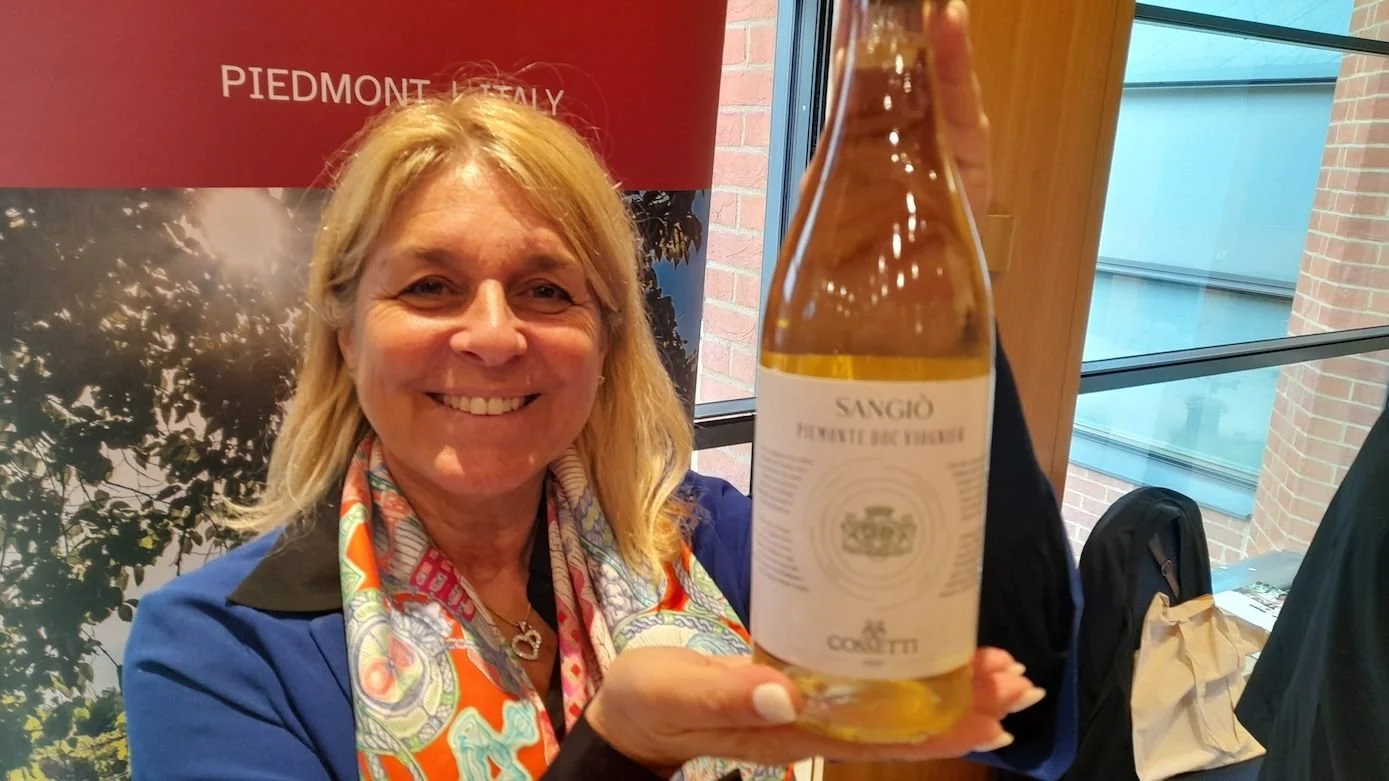
Talking of Piemonte, Cossetti’s Barolo DOCG Cinquantacinque 2019, is still quite young but with tremendous potential. Drinkable now, though, is Cossetti’s Barbaresco Cinquantotto 2019, whose fruit is enchanting and tannins approachable. With an abv of 14%, the wine is in perfect balance. “2019 was a very, very good year, although 2018 was the best,” co-owner Giulia Cossetti said. “We try to balance the tannins.”

Sancho Garces - the single Spanish producer

Mariola Varona

The one Spanish producer’s wines that ZONIN1821 Group imports is the co-operative Sancho Garces. Two hundred families who own 400 hectares in Rioja Alta send their grapes for vinification. These include not just Tempranillo and Viura but also Tempranillo Blanco.

“Adding 15% Tempranillo Blanco to the Viura is the best thing that ever happened to Rioja white wine,” Mariola Varona, the co-op’s export director, said. “It gives brightness, friskiness, acidity, fruit character and minerality, and combines so well with the backbone and structure of Viura. It's nicely balanced and very easy drinking.”

It was hard to disagree with Varona, who revealed the enticing Rioja DOC Crianza is ‘one of our best sellers’ (and value at £14.79 RRP).

From the Western Cape – Du Toitskloof

Also good value in the everyday drinking class was the range of another co-operative, Du Toitskloof. Founded in 1962 by six farmers in the Breedekloof district of the western Cape, it has expanded to 12 growers, who own 985 hectares of vines, including Chenin Blanc, Sauvignon Blanc, Chardonnay, Pinotage and Cabernet Sauvignon.

Ed Beukus

“We are a bulk producer, working with supermarkets, but also sell our branded wines through Zonin," export manager Ed Beukus said. “We are Fair Trade accredited, and are selling well here to pubs, bars and restaurants as we have very good quality at a very good price. You have to in a saturated market. Chenin and Shiraz are best sellers, and because the brand has grown so well in South Africa, we have had to start buying in grapes, with a lot of red from Swartland.”

Finally, from across the Atlantic, ZONIN1821 Group is bringing in some high quality red and white wines from its US winery, Barboursville Vineyards. Viognier is a grape that has long flourished in this state, and its Viognier Virginia Appellation 2017, which spent 11 months on the lees, showed very well. So too did its Nebbiolo Reserve Virginia Appellation 2015, with its approachable tannins, and Cabernet Franc Reserve Virginia Appellation 2017.


Domaine Chanson

Vincent Avenel on how Domaine Chanson is thinking outside the box

It’s a year since Bollinger-owned Domaine Chanson acquired a 45-hectare estate in Côte Chalonnaise, allowing this 275 year-old Burgundy négociant to future-proof its business. Geoffrey Dean visited the estate and talks in-depth with managing director Vincent Avenel about how key this acquisition has been in terms of his plans to balance the business model, replant rootstock, receive organic certification and completely rethinking Chanson’s business strategy. Avenel is justified in his belief, writes Geoffrey Dean, as they have the fruit, they have a team that is as harmonious as their wines and they have a dynamic, experienced managing director who thinks outside the box.

13th August 2024 by Geoffrey Dean

“Incroyable….utopie,” beamed Vincent Avenel. The charismatic managing director of Domaine Chanson Père et Fils might have been revelling in the runaway success of the Olympics, when thousands of hitherto absent Parisians returned early to the city mid-Games, fearful of missing the biggest party there since France won the World Cup at the Stade de France in 1998.

But Avenel was in fact looking back on a major transformation in the fortunes of one of the most venerable Burgundy négociant houses, whose founding predates the French Revolution. “Thinking of buying 40 hectares in Burgundy is like a dream - utopia,” he reflected. “We told our shareholders it would take 15 years to build this up, but we had the opportunity in one go. Incredible.”

Thinking outside the box: Vincent Avenel, Domaine Chanson, July 2024

Some background is useful here. Notwithstanding the prestige of its imminent 275th anniversary - in 2025 - Chanson Père et Fils was worried about the future. A strategic rethink, ordered during Covid by Etienne Bizot, president of owners, Bollinger, led consultants to conclude that its négociant business was at risk.

“The competition of small growers has become very strong as they don’t really need to sell their fruit,” Avenel explained. “They can vinify, bottle and sell themselves. And demand is so strong that customers are going direct to them. The business model of négociants was we buy fruit or must from growers, and then we vinify, age and sell. But now the raw material is missing because the small growers keep it for themselves. So business is dangerous, and we thought it best to have a larger estate where we know what we are going to get off Mother Nature.”

The issue, though, was how to increase holdings of 43 hectares in a region where sales are either rare and/or expensive. In the summer of 2022, however, word reached Domaine Chanson that the owners of a 45-hectare estate in Côte Chalonnaise named Château D’Etroyes were open to selling. Negotiations began in secret in July of that year, with other rival négociants kept in the dark, and carried on for another eight months before a deal was signed in March 2023.

“A group of eight gentlemen who had been very successful in finance and banking in France, India and Singapore had bought the estate in 2018,” Avenel revealed. “They were seduced by the idea of being owners of land in Burgundy but were very unlucky with the weather and small vintages apart from 2019. The estate needed some investment, and they saw it was going to cost them too much and it was better to sell. But when I visited the wines were at a good level.”

Chanson's cellars at Beaune - the estate's founding predates the French Revolution

Avenel would not reveal the purchase price, only that Chanson Père et Fils was happy with it. “It is always over-priced in Burgundy but in Côte Chalonnaise it remains at a more reasonable level,” he declared. “Prior to this acquisition, our model was 25% of the business based on domaine wines and 75% on negociant wines. Now, with this acquisition, we should be at 50:50. We should now be in a model to help us go through any kind of situation.”

The plan is to renew the vineyards at Château D’Etroyes, mainly in Rully and Mercurey, over the next 15 years.“That will have a cost but we know that, and are ok with that,” Avenel continued. “Long-term is the right way, and we are going to change a few things. The main efforts we have to make are in the vineyards; so we are reinforcing the team looking after them from seven people to 15, and have cut the administrative staff. To reduce the average vine age from 50 years to a more desirable one of 35, they will replant two hectares per annum there for the first 5 years, and then one hectare each year.”

All vinification is being carried out in Beaune, where it is easier to control quality. “The winery in Mercurey was a bit dated, and we have better facilities,” Avenel explained. “It’s too complicated to have two different wineries. For the whites, we press in Mercurey and send the must to Beaune for fermentation.”

There, the vinification facility, which was updated in 2010, is on the edge of town towards Savigny, with the company headquarters and maturation cellars located in town at Bastion de l’Oratoire, a late medieval stone tower that was one of Beaune’s principal fortifications.

Organics and the 2024 season

Biodiversity drive: bee hives at Clos des Mouches

Farming organically is now one of Chanson Père et Fils’ most closely embraced tenets. It will receive organic certification for the entire Beaune harvest this year, and has just begun the process of organic certification at Château D’Etroyes.

“There’s no price premium in Burgundy for organic wines, but some people won’t consider buying if they are not,” Avenel said. “We haven’t done it because it’s a trend, or for marketing, but to take care of the vines with more respect for the environment. It’s better for our employees too but it doesn't make life easy. You have to spray the organic products more often.”

Overseeing a major replanting programme: Justine Savoye, vineyard manager

This vintage has proved particularly testing, with both types of mildew - downy and powdery - a major problem. Persistent rain in the first half this growing season has encouraged the deadly duo. According to Chanson’s vineyard manager, Justine Savoye, as much as 100mm of rain fell in Beaune in June (ten times the normal amount) and 200mm in the Côte de Nuits.

“Many people have lost their entire crop, depending on the plot and the strategy of the domaine,” she said, as we walked through her vines. “This year in Clos des Mouches we sprayed 10 copper and sulphur treatments by early July, more than other years.”Domaine

Chanson’s embrace of experimental viticultural practices include the trial use of a new biofungicide treatment named 'Taegro' that is permitted in organic systems to counter both downy and powdery mildew. Half a dozen new rootstocks are also being trialled by Chanson with a view to replacing 161/49C, which is not resistant to drought. Many vines planted on it since the 1990s are suffering badly.

In addition, a biodiversity drive by Chanson has seen the repair and maintenance of its three kilometres of drystone walls, important habitat for multiple species of insects, snails, slugs, small birds and small mammals. And fittingly, given that the Clos des Mouches vineyard was named after bees (‘mouche à miel’ being the French for honey-bee), bee hives at the top of Chanson’s parcel have been re-established. Meanwhile, several Chanson rows of around 500 vines on a steep incline in the Premier Cru Les Bressandes vineyard are being grubbed up to be replanted with fruit trees.

What though of the wines’ direction?

Lucy Auger, cellar master, presenting the latest vintages

Avenel is clear about making wine as authentic and as pure as possible.

“We are a young team,” he said. “Lucy [Auger], the cellar master, started in 2020, Justine in 2019, and I in 2017. It was time to shake off the dust and ask what are the fundamentals and where we can be good. We’re not wanting to replace Bouchard with four million bottles or Jadot with 12 million. It’s not our goal at all - we are between 600,000 and one million bottles per year depending on the vintage. If we can do more, we will do but the first goal is to produce the best wine in that category. We might be the second or third best, but if we are in the top three we are super happy. And we don’t want to invent a style. We want to produce wine that is authentic and pure as can be.”

A key technical change was made when Auger took over with the abandonment of 100% Pinot Noir whole-bunch fermentation, an unusual practice among Burgundy’s larger-scale producers. This has been reduced to between 25-50%.

“We don’t do things with a systematic approach - we try to adapt to each vintage, each plot,” Avenel continued. “We might be wrong sometimes but we learn and hopefully we improve. It’s something I’ve learnt working for different companies - there is not one magic recipe. I want to emphasise that it’s not a one-man decision at Chanson. Lucy, Justine and I taste wines together and other wines from the competition - blind - and ask ‘are we far from the best, what are the best?’ and try to be inspired by that. We try to build a shared view of where we should go.”

Above all, Avenel knows that shedding the sometimes negatively in-built view of négociants will require patience and time. “When you take decisions you know it’s going to take five, six perhaps ten years,” he sighed. “In terms of image, it takes a lot of time. People have very strong preconceptions. When you start with a négociant image, you really start with a handicap because people tend to think negociants are big and have average wines and are not consistent, which is totally wrong but that’s the preconception because it was based on something that happened 30 or 40 years ago. But nowadays the borders are not very clear because you have growers that become négociants, and négociants that become landowners.

“Our goal is to be among the best in the category and appellation where we are. That’s going to happen when the markets and opinion leaders say it’s happened. We want to show what we’ve been doing in the last six or seven years. We want to renew or change the mindset of people so it’s not a preconception but something based on fact and the things that are really happening. And hopefully, this will grow slowly but surely, and people will think Chanson is not at all what they thought initially. When I joined Faiveley in 2007, their image was terrible, with an undrinkable style of wines, but now if you read the magazines and journalists, Faiveley is quite high now, and it has been a huge change.”


Avenel modestly credits Bernard Hervet not himself for masterminding the turnaround at Faiveley, who doubled their turnover of €nine million between 2007 and 2016. Avenel thinks Chanson’s medium size is a big plus in its quest for greater recognition.

“We’re not small, not big - we have the best of both worlds,” he concluded. “Our focus is not on volume, it’s on quality, and we have a strength compared to smaller growers in that we have a team of specialists. We are right in between which gives us a great advantage.” He is justified in his belief - they have the fruit, they have a team that is harmonious as their wines and they have a dynamic, experienced managing director who thinks outside the box.


Four Chanson wines that caught the eye

Domaine Chanson Corton-Vergennes Grand Cru, 2022

From a 0.65 hectare plot adjacent to Corton-Charlemagne, this was the pick of the whites tasted. Smoky, spicy nose with aromas of white flowers; citrus lime, white peach, apple and earthy wet stone notes on the palate; powerfully structured, yet charming with elegant backbone and taut acidity. Tightly focused and very mineral, complex, long finish.

Domaine Chanson Beaune Premier Cru Clos des Mouches, 2022

From a parcel on a vineyard renowned for producing some of Beaune’s finest white wines. Aromas of pear, vanilla, clove and nutmeg; tight citrus freshness at its core with peach and exotic mango notes; beautiful, tension-filled intensity with linear precision and saline-infused, persistent finish, enhanced by subtle minerality. Grand Cru quality in all but name.

Domaine Chanson Beaune Premier Cru Les Grèves, 2022

From a steep 2-hectare plot with gravelly soils. Strawberry on the nose with herbal, smoky aromas. Bold, dark berry fruit, notably black cherry, on the palate with hints of game. Sensuous, very well-handled tannins provide shape. Plenty of freshness to partner terrific complexity and concentration. Impressive, mineral-inflected length. 20% new oak.

Domaine Chanson Beaune Premier Cru Clos des Fèves, 2022

From a 3.8 ha monopole that has been registered since 1307. Fabulous nose with lifted and perfumed aromas with hints of roses, strawberries and spice. Gorgeous red fruit, with classy black cherry also evident. Olive, chocolate, tobacco and earthy notes add complexity. Structure from 20% new oak. Alluringly textured mouthfeel with super-fine, silky tannins and magnificent concentration and length. If there was a reclassification, this would be a shoe-in Grand Cru. The makings of a great Burgundy.


The wines of Domaine Chanson are imported and sold in the UK by Mentzendorff which is a commercial partner of The Buyer.